Monday, January 30, 2023

When "Dark" NOCs are a Good Thing

Not so long ago, a phrase such as "dark network operations center" might have been a huge problem, implying the NOC has gone down. These days, some use the phrase in a different way, to denote an automated NOC.


“Zero touch” operations have been a desired process goal for most connectivity firms for many decades.


The "dark" network operations center is one expression of the desired outcome. It implies an operation whose surveillance capabilities are so advanced the NOC does not require people to monitor what is going on.


To be sure, automation and other ways to  reduce friction and manual processes generally are desired in virtually all data center and communications network operations and processes these days


Beyond that, the same general push towards automated operations arguably applies to most other retail-related or end-user related processes. 

Websites and customer self-provisioning are expressions of those objectives. A frictionless business might use artificial intelligence or machine learning to achieve:

  • 100 percent efficiency and knowledge of buyer demands, preferences, and tastes

  • complete understanding, in real-time, of the state of a firm’s supply chain

  • as-good-as-can-be-expected employee productivity, based on knowledge of actual behavior

  • full effectiveness of all information technology systems, devices, and software

  • real-time knowledge of any legal or regulatory compliance issues

  • robust feedback loops and intelligence gathering that aids in the development process for new products and features

Friday, January 27, 2023

Data Center Value Now Hinges on Connectivity


In the cloud era, when remote computing is the norm, processing and storage have value only when end users and content, app or platform suppliers can reach each other. Hence the need for robust data center connectivity to the internet and IP networks generally. 

Wednesday, January 25, 2023

Sustainability as Storytelling

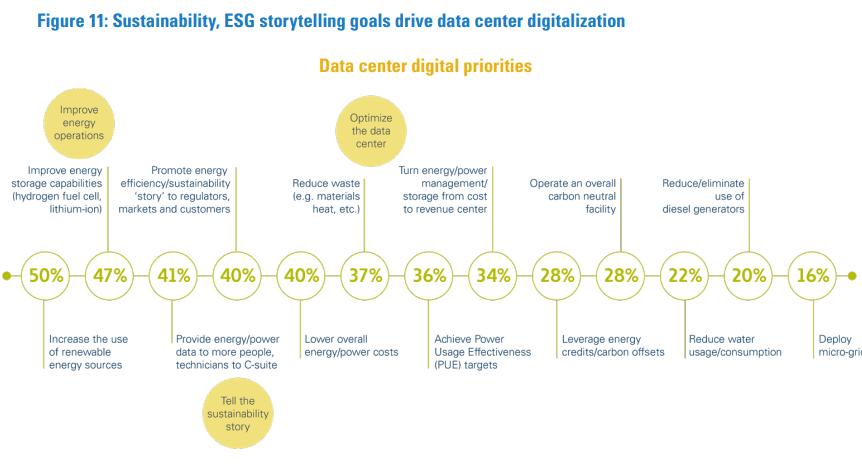
Data centers spend quite a lot of money on electricity and power, so reducing consumption makes excellent business sense. But “storytelling” about sustainability also is aimed at regulators who need to be pacified, as well. 


Operating costs aside, data centers need to assure potential regulators that they are doing everything they can to reduce carbon footprint and energy consumption. The trick is to do so without undue damage to the operating business and financial performance. 

source: Eaton 


The point is that all sustainability, diversity or inclusion goals have an implied cost. The trick is to succeed without sacrificing basic business performance. 


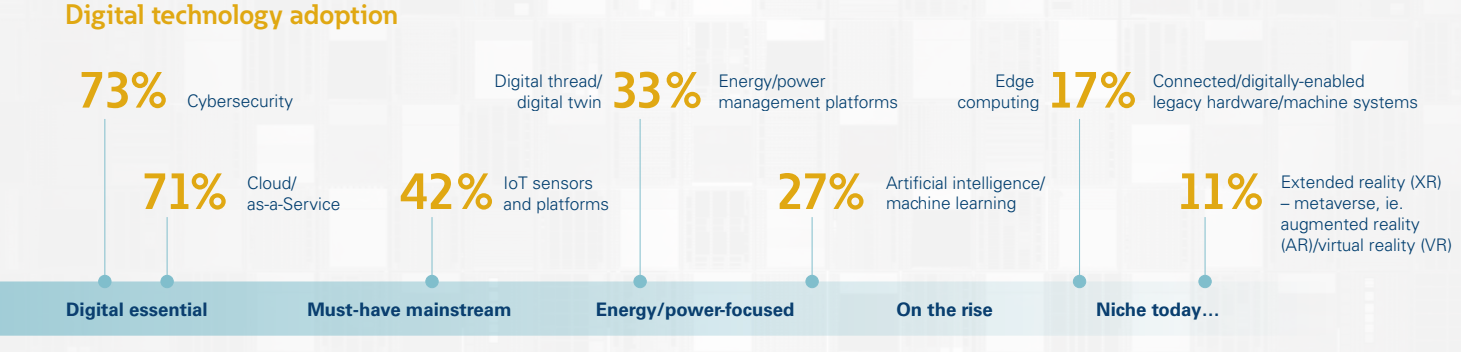
It is the same sort of fundamental logic CxOs have to apply to the rest of their operations. Those information technology initiatives that promote and protect the current business get deployed first. Other initiatives that promise benefit, but over a longer time horizon, are deployed in a measured way.


Initiatives that promise future benefit get less attention and funding. Sustainability (energy consumption and carbon footprint) are most often somewhere in that middle ground, unless regulators threaten to make it an immediate business issue. 


source: Eaton 


When that happens, the financial impact of compliance on the business becomes secondary. Data centers simply must do enough, and spend enough, to convince regulators to leave them alone.


Tuesday, January 24, 2023

LAN Versus WAN Traffic Volumes: 80-20 Rule Probably Still Holds

Historically, more data has moved on local area networks of all types than across public and private data networks. That was true in the client-server era and arguably remains true in the cloud computing era. Even looking at consumer data consumption, which one might arguably claim is 80-20 in favor of WAN-delivered content versus local on-premise data sharing, most of that end-user-consumed or sent data is over private Wi-Fi--hence local area networks--even if the access connection implies that most data is device to cloud and cloud to device.


Given wide use of Wi-Fi as the LAN medium, device-to-cloud and cloud-to-device data transfers usually feature nearly-identical amounts of data movement "across the LAN" (Wi-Fi) as "across the WAN" (device to cloud to device).


The point is simply that growth of public network data volumes is a reflection of internet app use overall, and hence derivative of that use. That, in turn, has made data centers the focal point of data transfer requirements.


By some estimates there are 8,000 data centers globally, looking primarily at public (multi-tenant) and other large data centers supporting cloud computing. Of course, that only enumerates the big public and hyperscale data center sites. Forecasts suggest we are headed for more than 1,000 such centers by perhaps 2026.  


If we include all private enterprise and other entity data centers, there could be as many as seven million data centers operating globally. We sometimes forget how those facts have shaped global data networks. 


Some 50 or 60 years, global data traffic largely moved between telephone company central offices. Data network traffic was logically and often physically distinct, moving between private data centers on dedicated facilities and logical networks. 


source: Cisco 


These days, data moves between data centers and to end users of data from data centers. Central offices still function, but their contribution to volume is negligible. 


source: Statista 


Electricity consumption is one example of footprint, but the bigger implication for much of the connectivity business is the shaping of data communications volume. Traffic volume moving between data centers is just about equal to data served up to, and coming from, actual end users globally. 


Internet workloads in the cloud computing era drive traffic across networks, both between data centers and to end users who are the ultimate consumers. Far more traffic moves within each data center. 


source: IEA 


Edge computing might eventually shift some traffic off wide area networks and confine it locally. Just how much impact edge computing will have on WAN traffic is hard to determine right now. It might be quite fair to predict that cloud WAN traffic will continue to grow even if edge computing moves some workloads off remote data centers.  


At a high level, traffic moves between places where internet use is highest. Up to this point, that has meant east-west between Europe, North America and Asia. South-to-South and Europe-to-Africa are growth areas.

Sunday, January 22, 2023

How Big an Issue is Macro Economic Uncertainty?

Challenging is the way some might characterize 2022 data center industry trends, if looking at issues such as sustainability or security, mergers and acquisitions or capacity issues. Growing investor demand also has boosted asset prices, with predictable impact on transaction markets. 


Macro economic conditions are another mattrer. If economic activity contracts, dafa center services demand shouild see some negative pressure. The issue is that nobody seems to have a clear view of where we are or where we are headed, in that regard.


So far, edge computing has been arguably less controversial, as it drives a minimal amount of revenue for data center providers at the moment. Sure, it is coming, but the revenue impact remains slight, so far.


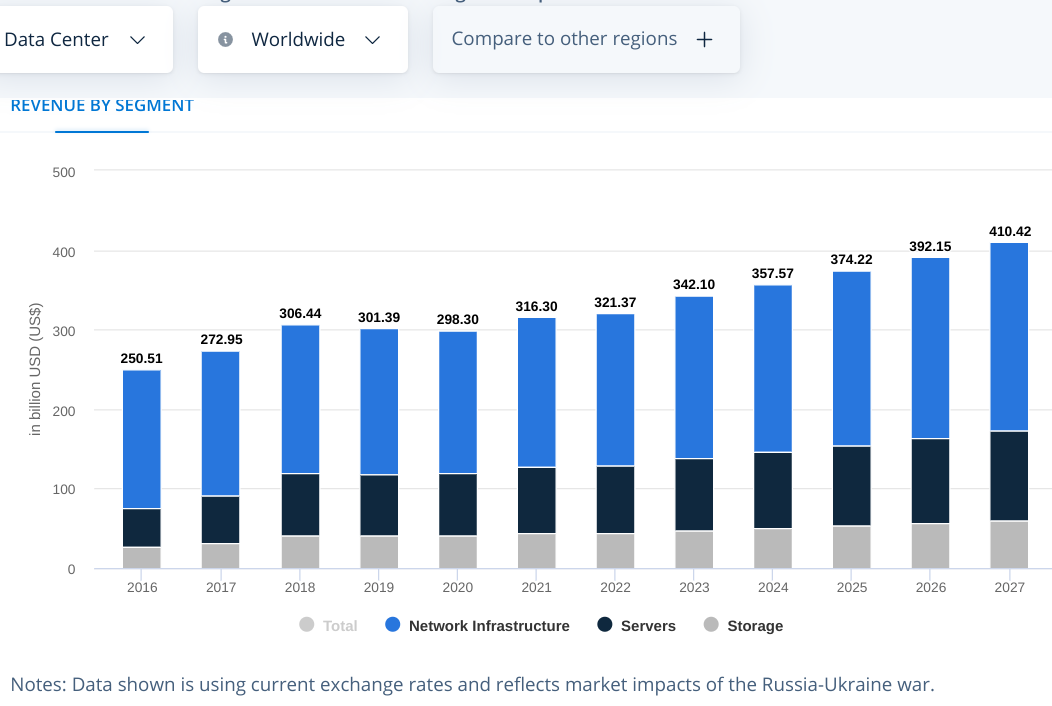
Others will point to steady demand growth as positives, even if 2022 saw headwinds in terms of growth rates. 


source: Statista   


But economic conditions probably are weighing on the business, in addition to supply chain issues, war, inflation and economic recession fears. In short, the macro environment is volatile. 

source: Cushman Wakefield 


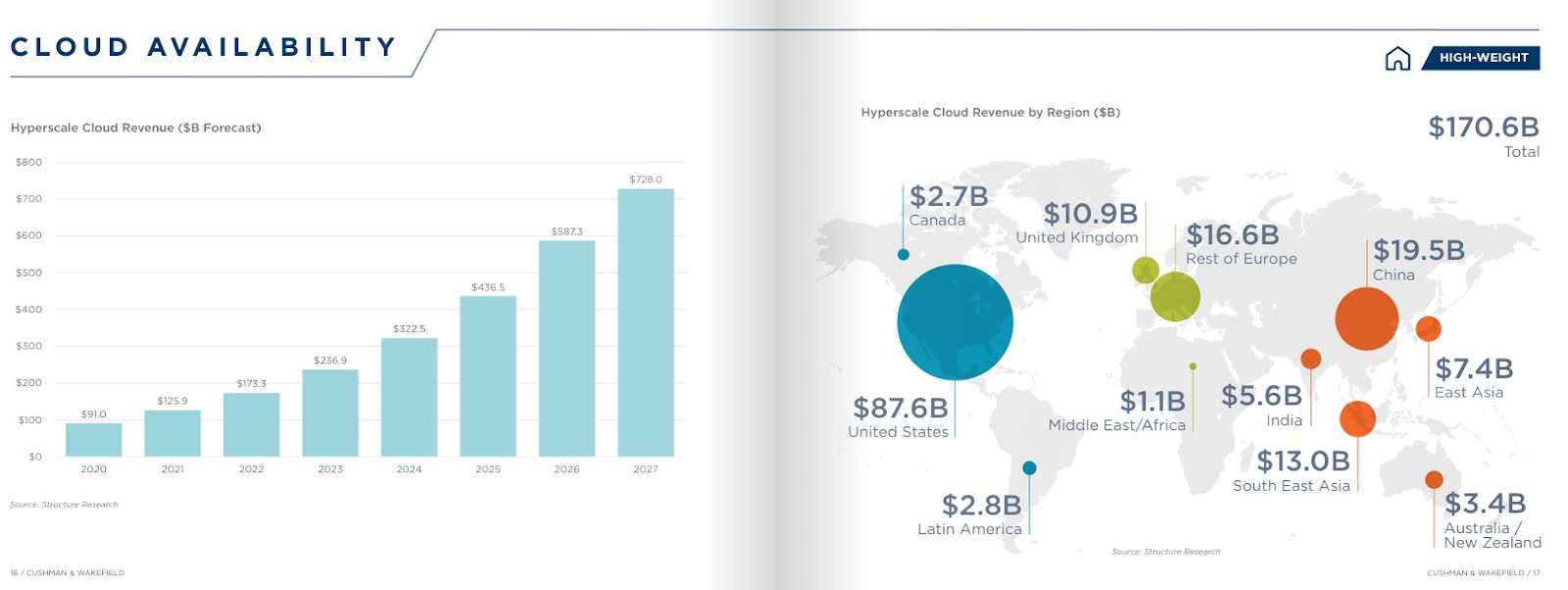
How much an issue macro economic issues might play is a bit unclear. Underlying demand growth might be the key trend, but economic slowdowns will affect spending by enterprises on information technology. And technology suppliers seem to be preparing for more-challenging conditions in 2023. 


Hyperscale app providers are reducing headcount, which provides some evidence of their expectations about their own fortunes in the near term. But uncertainty might be higher than usual as monetary officials battle high inflation with higher interest rates intended to slow the economy down, raise unemployment, reduce asset prices and wage demands under conditions that seem in some ways stubbornly resistant to those policy moves. 


So to the extent that macro economic conditions matter for the data center business and other industries in technology and communications, asset trends before and after any typical recession provide something of a Rorschach test: what do you see in the economic picture? 


Perhaps more to the point, where in the economic cycle are we? In recession or pre-recession? And how deep might any recession be? How likely is a “soft landing” that breaks the inflation cycle without plunging economies into negative growth?


source: Bloomberg, Yahoo 


 Uncertainty ls the watchword in financial markets at the moment and volatility is the result. How much that can, or will, affect data center markets also is a bit unclear. 


Wednesday, January 4, 2023

Cloud Repatriation Partially Explains Hybrid Cloud Growth

“You’re crazy if you don’t start in the cloud; you’re crazy if you stay on it,” Andresssen Horowitz has said, talking about company use of public cloud computing. So observers have talked for some time about cloud repatriation, the shift of workloads from public cloud back to private cloud. 


Workload migration back to private cloud should not really come as a surprise. In virtually all other areas of enterprise information technology, total cost of ownership changes as volume grows. When any workload is light, buying a service almost always costs less than when workloads are heavy. 


That is why hosted voice services offer value to smaller businesses and entities: the cost of renting lines generally provides higher value and lower cost than owning a business phone system. But in high volumes, the cost of renting lines will exceed the cost of owning a phone system. 


The same trade off arguably exists for virtually every other IT product. The economics favor renting at low volume and owning at high volume. So we see the paradox: public cloud computing spending seems to climb every year, but enterprises also are moving some workloads back to their own private clouds.


source: Verified Market Research


That is why forecasts for hybrid computing also are predicted to increase. 


Thursday, December 29, 2022

Containerized Edge Computing Forecast

“What is the edge?” is a big question these days, as an answer has to be formulated before we can figure out where revenue growth opportunities might lie, and for whom those opportunities exist. 


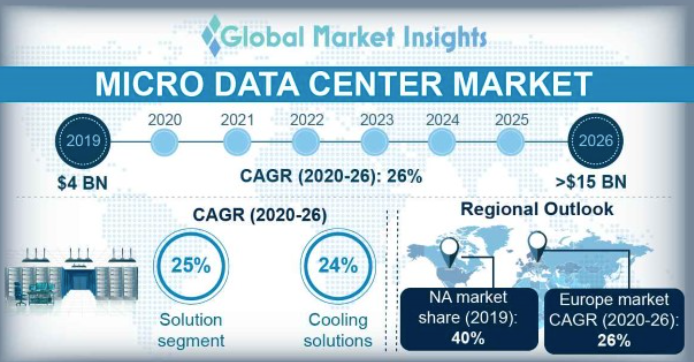
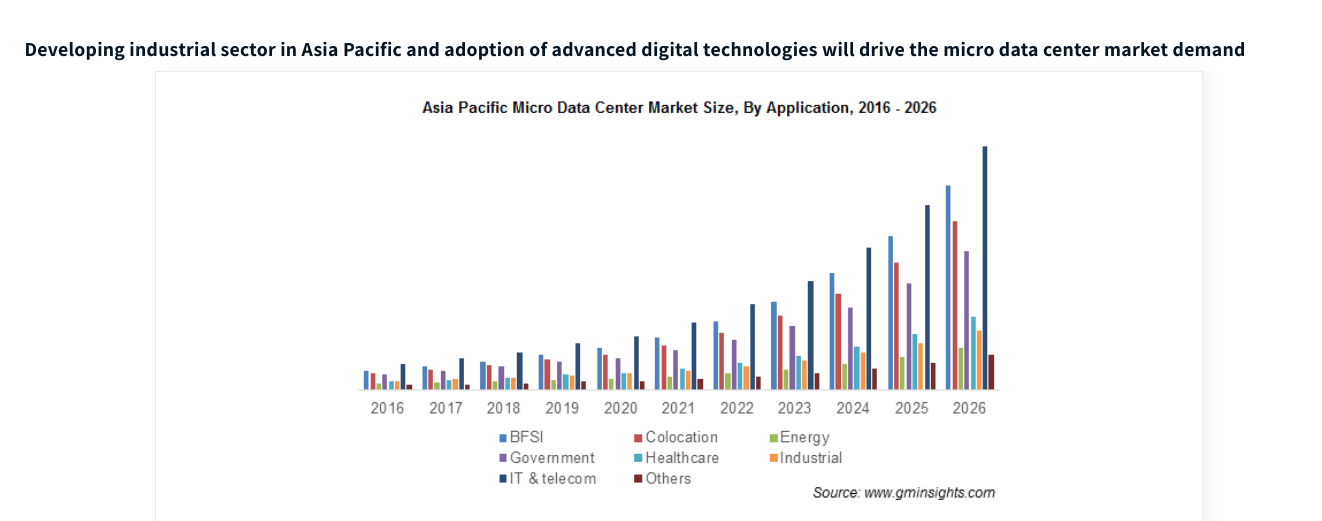
Containerized miniature data centers are one expression of edge computing. In Asia-Pacific markets, as well as others globally, the likely revenue participants are server suppliers, cloud computing firms and those in the ecosystem who support the supply of the containerized and racked computing facilities. 


source: Global Market Insights


As with most other information technology platforms, a majority of revenues will likely flow to hardware and software supplies and system integrators. 

source: Global Market Insights

Wednesday, December 21, 2022

Cloud Keeps Growing, Issue is Whether Some Use Cases Switch Back to--or Remain--Private

Everyone seemingly agrees cloud spending is growing, and growing faster than private cloud or traditional enterprise private computing. But some analyses of spending suggest the market is still young. Public cloud spending might still represent just single-digit portions of enterprise information technology budgets. 


By now, cloud computing advantages are clear enough: lower cost for growing and small companies; unpredictable workloads and flexibility. The downsides might include security, downtime, vendor lockin, data portability and even cost when workloads are sufficiently large or unmonitored.  


Mid-sized companies with stable workloads might actually find that public cloud costs more than using in-house private computing. That might be true for small workloads and simple apps, or highly-irregular and “spikey” compute volume, some argue. 


Still, Gartner analysts say that in enterprise IT categories that can transition to cloud--application software, infrastructure software, business process services and system infrastructure--by 2025, 51 percent of IT spending in these four categories will have shifted from traditional solutions to the public cloud.


Figure 1: Sizing Cloud Shift, Worldwide, 2019 – 2025

souce: Gartner


Security or criticality probably will remain drivers for private computing, both cloud and traditional.  And we will have to see whether total cost of ownership at scale tips decisions back towards private computing, as volume grows for any single entity.

Friday, December 16, 2022

HPC or Data Storage: Rural Data Centers Could Go Either Way

It remains to be seen how high-performance computing, data storage, colocation and cloud computing use cases might change over the next decade, beyond the expectation that change will happen. Edge computing, for example, will disperse some compute resources. 


Storage might further centralize, and could shift to new locations in remote areas where power costs are low, even if the storage sites are in rural areas. 


High-performance computing might take a couple of paths, depending on the use cases. Real-time apps are likely to need facilities that are near large population centers where such apps are required and where access to wide area and metro networks is plentiful.  


 Applied Digital Corporation, for example, is building a specialized processing center, a five-megawatt  facility next to the Company’s currently operating 100-MW hosting facility in Jamestown, North Dakota. 


The new center was designed and purpose-built for graphics processing units and is designed to run high performance computing applications including natural language processing and machine learning.


The new 16,382-square foot building is planned for energization in the first calendar quarter of 2023.


The hope is that new high-performance apps can be run at such remote data centers. Perhaps obviously, such apps would not be latency sensitive or especially designed to support real-time processing needs. 


It remains to be seen whether HPC-optimized data centers located in areas with very low cost energy, but located far from metro areas, could become a new niche within the cloud computing and data center industries. 


It might seem equally plausible that such areas might also become more important for bulk data storage, which likewise does not require real-time response.


Sunday, December 11, 2022

Who Really Wins New Revenue from Edge Computing?

One rule of thumb I use for determining whether any proposed new line of business makes sense for tier-one connectivity providers is whether the new line has potential to produce a minimum of $1 billion in annual revenues for a single provider in some definable time span (five years for a specific product. 


By that rule of thumb, tier-one service providers might be able to create edge computing revenue streams that amount to as much as $1 billion in annual revenue for some service providers. But most will fail to achieve that level of return in the next five to seven years.


That is not to say "computing at the edge" will be a small business. Indeed, it is likely to account for a growing part of public cloud computing revenues, eventually. And that is a big global business, already representing more than $400 billion in annual revenues, including both public cloud revenues as well as infrastructure spending to support cloud computing; the value of business applications and associated consulting and services to implement cloud computing.


The leading public cloud computing hyperscalers themselves represent about $72 billion or more in annual revenues already. All the rest of the revenue in the ecosystem comes from sales of software, hardware and services to enable cloud computing, both public and private.


source: IoT Analytics


It is likely a reasonable assumption that most public edge computing revenue is eventually earned by the same firms leading public cloud computing as a service.


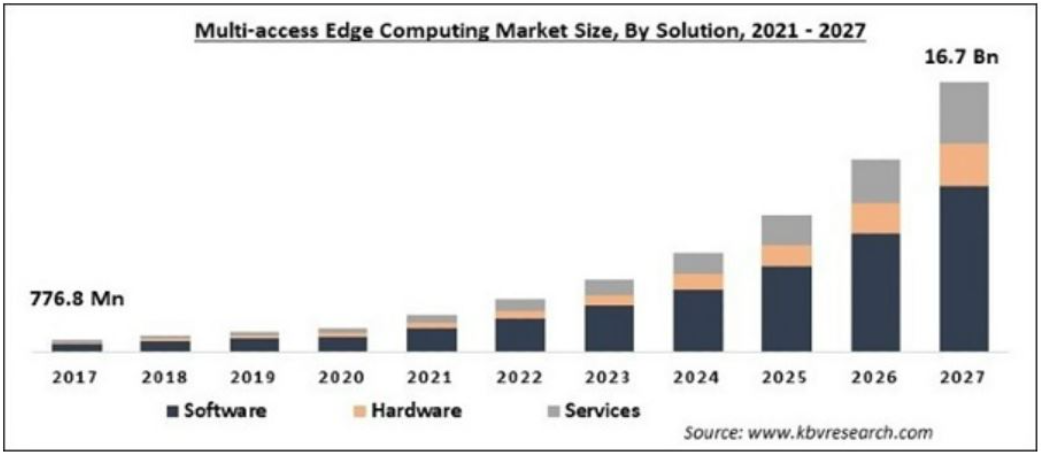
Perhaps service provider revenues from edge computing could reach at least $20 billion, in about five years. By that standard, multi-access edge computing barely qualifies as "something worth pursuing," at least for tier-one connectivity service providers.


In other words, MEC is within the category of products that offers reasonable hope of payback, but is not yet in the category of “big winners” that add at least $100 billion to $200 billion in global service provider revenues. 


In other words, MEC is not “mobile phone service; home broadband. Perhaps it will be as big as MPLS or SD-WAN. For tier-one connectivity providers, perhaps MEC is more important than business voice (unified communications as a service). 


source: STL, KBV Research 


As with many other products, including Wi-Fi, SD-WAN, MPLS, 4G or 5G private networks, local area networks in general and  enterprise voice services, most of the money is earned by suppliers of software (business functionality) and hardware platforms, not end-user-facing services. 


The reason is that such solutions can be implemented on a do-it-yourself basis, directly by enterprises and system integrators, without needing to buy anything from tier-one connectivity providers but bandwidth or capacity. 


So one reason why I believe that other new connectivity services enabled by 5G likely do not have the potential to substantially move the industry to the next major revenue model is that none of those innovations are very likely to produce much more than perhaps one percent of total service revenues for the typical tier-one service provider. 


The opportunity for big public connectivity providers lies in use cases related to the wide area network rather than the domain of indoor and private networks. That is why the local area networks industry has always been dominated by infra providers (hardware platforms) and users who build and own their own networks (both enterprise and consumer). 


And most of the proposed “new revenue sources” for 5G are oriented towards private networks, such as private enterprise local area networks. Many of the other proposed revenue generators can be done by enterprises on a DIY basis (edge computing, internet of things). Some WAN network services--such as network slicing--attack problems that can be solved with DIY solutions.


Edge computing is a solution for some problems network slicing is said to solve, for example. 


None of the new 5G services--or new services in aggregate-- is believed capable of replacing half of all current mobile operator revenues, for example. And that would be the definition of a “new service” that transforms the industry. 


All of which suggests there is something else, yet to be discovered, that eventually drives industry revenue forward once mobility and home broadband have saturated. So far, nobody has a plausible candidate for that new service.


Edge computing might be helpful. So might network slicing, private networks or internet of things. But not even all of them together are a solution for industry revenue drivers once home broadband and mobile service begin to decline as producers of at least half of industry revenues.


It already seems clear that others in the edge computing ecosystem--including digital infra providers and hyperscale cloud computing as a service suppliers--will profit most from edge computing.


Sunday, December 4, 2022

Size Should Correlate with Profit: for AWS and Alphabet, that is Clear

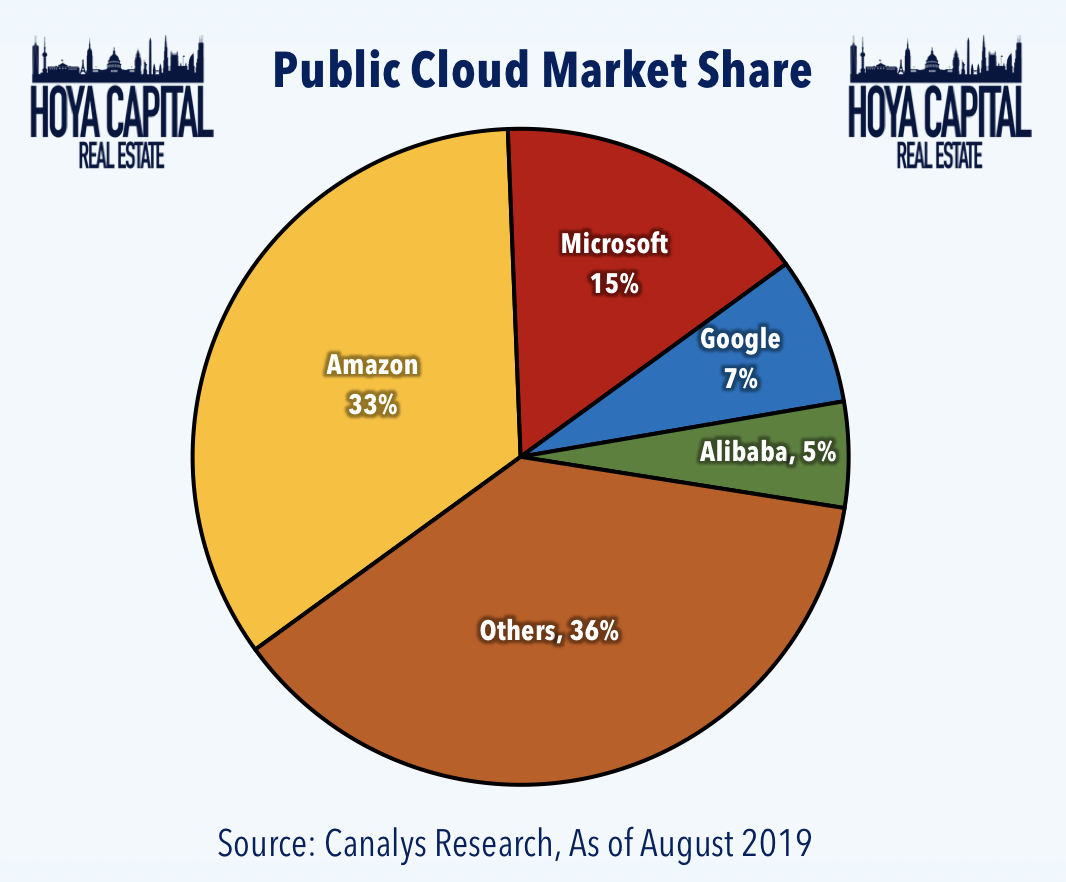
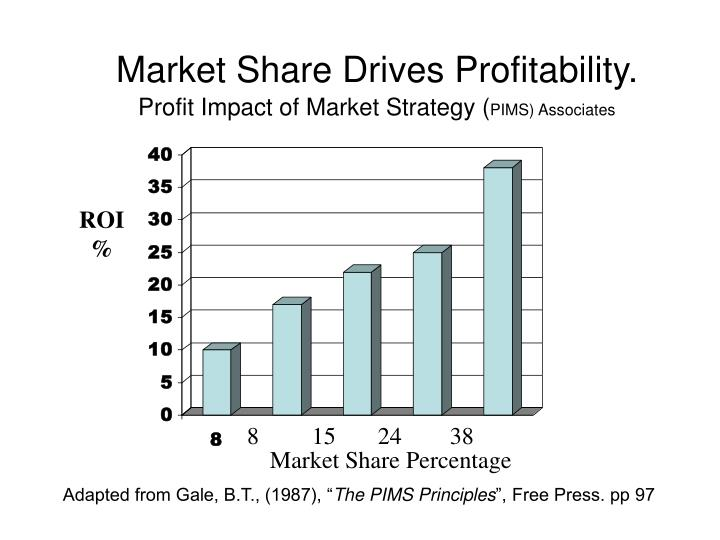
Data center providers with double the share of their closest competitor lead their markets in profitability. The reason is the relationship between market share and profit margin or return on investment.


That is arguably true in the connectivity and data center markets as well, though impossible to verify as Microsoft Azure never releases margin data.  Alphabet profit margins are said to be quite low, in the single-digits range. AWS margins are in the 61 percent range.  


Since Microsoft has never published its profit margins from public cloud services, it is hard to say for certain that the expected pattern holds. 

Profit margin almost always is related to market share or installed base, at least in part because scale advantages can be obtained. Most of us would intuitively suspect that higher share would be correlated with higher profits. 


That is true in the connectivity and data center markets as well. 

source: Harvard Business Review 


But researchers also argue that market share leads to market power that also makes leaders less susceptible to price predation from competitors. There also is an argument that the firms with largest shares also outperform because they have better management talent. PIMS researchers might argue that better management leads to outperformance. Others might argue the outperformance attracts better managers, or at least those perceived to be “better.”


Without a doubt, firms with larger market shares are able to vertically integrate to a greater degree. Apple, Google, Meta and AWS can create their own chipsets, build their own servers, run their own logistics networks. 
source: Slideserve 


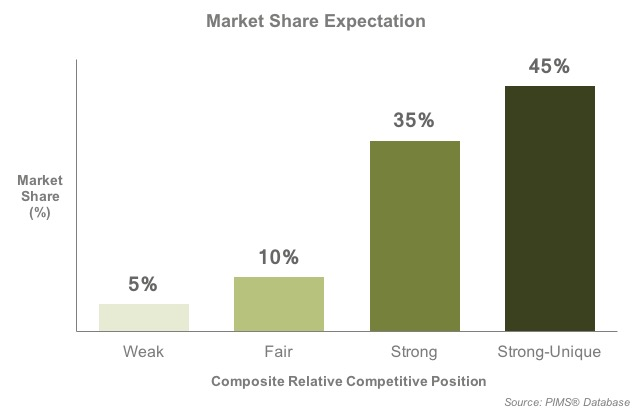
The largest firms also have bargaining power over their suppliers. They also may be able to be more efficient with marketing processes and spending. Firms with large share can use mass media more effectively than firms with small share.


Firms with larger share can afford to build specialized sales forces for particular product lines or customers, where smaller firms are less able to do so. Firms with larger share also arguably benefit from brand awareness and preferences that lessen the need to advertise or market as heavily as lesser-known and smaller brands with less share. 


Firms with higher share arguably also are able to develop products with multiple positionings in the market, including premium products with higher sales prices and profit margins. 

source: Contextnet 


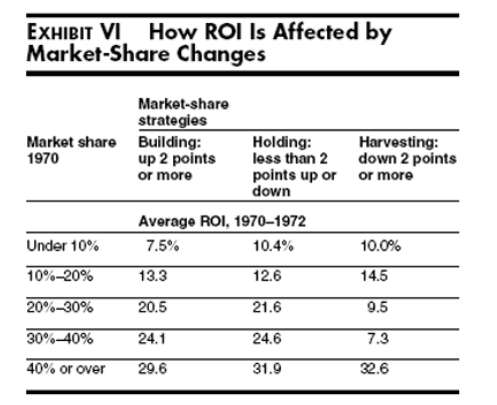
That noted, the association between higher share and higher profit is stronger in industries selling products purchased infrequently. The relationship between market share and profit is less strong for firms and industries selling frequently-purchased, lower-value, lower-priced products where the risk of buying alternate brands poses low risk. 


The relationships tend to hold in markets where firms are spending to gain share; where they are mostly focused on keeping share or where they are harvesting products that are late in their product life cycles. 
source: Harvard Business Review 


The adage that nobody gets fired for buying IBM” or Cisco or any other “safe” product in any industry is an example of that phenomenon for high-value, expensive and more mission-critical products. 


For grocery shoppers, house brands provide an example of what probably drives the lower relationship between share and profit for regularly-purchased items. Many such products are actually or nearly commodities where brand value helps, but does not necessarily ensure high profit margins. 


On the other hand, in industries with few buyers--such as national defense products--profit margin can be more compressed than in industries with highly-fragmented buyer bases. 


Studies such as the Profit Impact of Market Strategies (PIMS) have been looking at this for many decades. PIMS is a comprehensive, long-term study of the performance of strategic business units  in thousands of companies in all major industries. 


The PIMS project began at General Electric in the mid-1960s. It was continued at Harvard University in the early 1970s, then was taken over by the Strategic Planning Institute (SPI) in 1975. 


Over time, markets tend to consolidate, and they tend to consolidate because market share is related fairly directly to profitability. 


One rule of thumb some of us use is that the profits earned by a contestant with 40-percent market share is at least double that of a provider with 20-percent share.


And profits earned by a contestant with 20--percent share are at least double the profits of a contestant with 10-percent market share.


This chart shows that for connectivity service providers, market share and profit margin are related. Ignoring market entry issues, the firms with higher share have higher profit margin. Firms with the lowest share have the lowest margins. 

source: Techeconomy  


In facilities-based access markets, there is a reason a rule of thumb is that a contestant must achieve market share of no less than 20 percent to survive. Access is a capital-intensive business with high break-even requirements. 


At 20 percent share, a network is earning revenue from only one in five locations passed. Other competitors are getting the rest. At 40 percent share, a supplier has paying customers at four out of 10 locations passed by the network. 


That allows the high fixed costs to be borne by a vastly-larger number of customers. That, in turn, means significantly lower infrastructure cost per customer.