Monday, January 20, 2020

Thursday, January 16, 2020
Where is the Edge?
Edge computing is one of the more-flexible concepts in the computing universe. It can refer to computing on a device, on the premises or on the network edge. The “telecom edge,” in some cases, refers to small data centers located as much as 30 miles from a device or location requiring edge computing support.

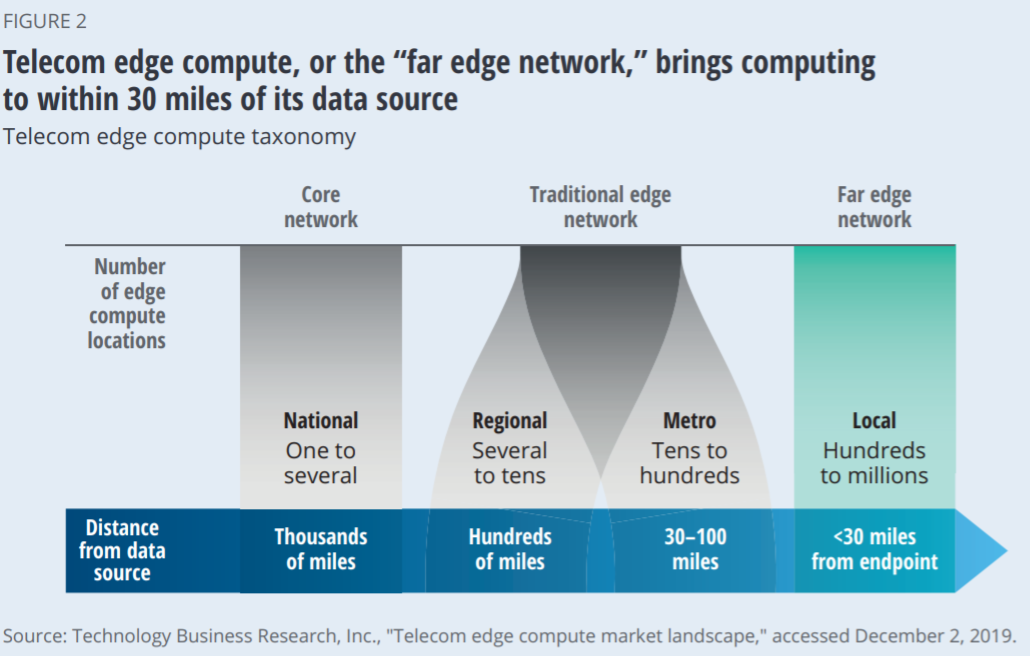
Another way of describing the venues is that device computing is consumer edge, with computing happening on the end user device. The enterprise edge might happen at one or more servers on a premises. A telecom edge location would then be outside any single enterprise location, but within a single metro area.

Most Enterprise Data Will be Generated at the Edge
While today only 10 percent of all data is handled at the edge, analysts expect in three years between 50 percent and 75 percent of all data to be produced and processed at the edge,” said Paul Morgan, global sales for manufacturing, automotive and IoT, HP Enterprise. “Gartner puts the figure at 75 percent.”
Wednesday, January 15, 2020
Edge Computing for Global Enterprises
América Móvil, KT, Rogers, Telstra, Verizon and Vodafone have formed the 5G Future Forum to develop interoperable 5G specifications--including mobile edge computing--across key geographic regions, including the Americas, Asia-Pacific and Europe.
The whole point seems to be creation of a seamless global capability for large enterprises with global operations who seek internet of things and edge computing as a service.
The 5G Future Forum says it will focus on the creation of uniform interoperability specifications to improve speed to market for developers and multinational enterprises working on 5G-enabled solutions including machine learning at the edge, autonomous industrial equipment, smart cars and cities, Internet of Things (IoT), augmented and virtual reality,
Tuesday, January 14, 2020
Equinix Buying Packet to Provide Edge Computing
Equinix is acquiring Packet, a bare metal automation platform, a move many will interpret as preparation for more edge computing.
“Bare metal” is a single tenant server, not a shared “cloud” approach to using server resources. This means only a single customer has full use of server resources,
Packet's proprietary technology automates physical servers and networks without the use of virtualization or multitenancy, allowing Equinix to add new on-demand deployment alternatives at the edge, using owned physical resources or Equinix “as-a-service” computing.
Friday, January 10, 2020
Edge Computing as a Business, Not Technical, Issue
The ultimate importance of edge computing to a telco has several dimensions. First, edge computing supports a telco's own operations, in a virtualized environment that 5G demands. A few revenue-generating roles also are possible, ranging from colocation and rack space to actual edge computing as a service operations.
Edge computing as a service supplied by a connectivity provider is based at least in part on the ability to repurpose central office assets, ranging from real estate, power and cooling to rack space and partitioned server access.
Central Office Re-imagined as a Datacenter is one effort to create that new platform, at least in part because 5G is expected to require such support. So as long as computer rooms must be built to maintain 5G operations, it is logical to consider what else might be done with those assets.
Network slicing, the ability to easily (or relatively easy) create virtual private networks, is one reason former central offices are becoming data centers. Virtualization is another reason. Also in an edge computing environment run by a telco, there has to be some way to separate an enterprise VPN data stream from all other traffic.
That is where the local breakout function becomes key. Local breakout allows enterprises to separate their own private traffic from the mobile service providers’ other traffic, at a gateway.
In principle, that might allow an enterprise VPN to terminate its local traffic at a gateway and then forward that traffic to its own or some other third party data center without necessarily using the telco’s own edge computing facilities.
There are lots of business issues here, of course. On one hand, a telco edge computing provider might not want to make it easy for enterprises to choose other edge services suppliers. On the other hand, neutral host operation might be necessary. And, much as multi-cloud often is preferred, so too might customers want the option to compute at more than a single edge site, using one or more providers.
How Big an Edge Computing Issue is Three-Phase Power?
Perhaps it is not the most-common challenge one will hear about edge computing, but the availability of three-phase power is an issue for edge computing, albeit an issue firms such as Schneider Electric are solving.
Schneider Electric’s Edge Module includes single- or three-phase power, N+1 standard cooling, and package cooling units mounted on the outside of the module to eliminate the need for external condensers or piping, the company notes.
The Edge Module is specifically suited to the cell tower edge with its single-phase design equipped for 208 volts of power and supporting six racks.
The issue is that server farms are expected to require access to high-voltage, three-phase electricity, and cannot use 120 volt AC, which is single phase. Three-phase is used by electrical transmission facilities and supports heavy power loads for big motors, for example.
The issue is that cell towers have not generally had access to three-phase power, as it was not needed. The typical base station requiring less than 10kW will only be using single-phase power, experts tend to agree. Three-phase power would be used at power levels of 20kVA of alternating current and above, which will tend to be the case for server farms, experts also tend to agree.
Three-Phase Power is an Edge Computing Issue
When edge facilities are colocated with cell towers, three-phase power often will be needed, but the cell sites tyically only have single-phase capability.
Thursday, January 9, 2020
Wednesday, January 8, 2020
Friday, January 3, 2020
Telco Edge Computing Prospects Already Dimmed
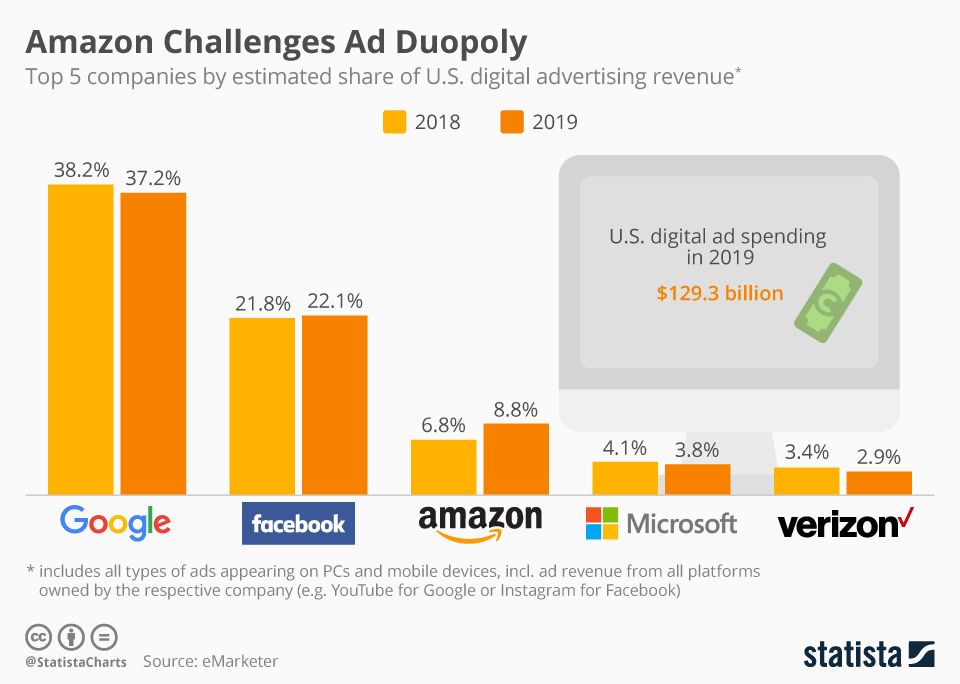
When one thinks about online advertising, most of us would guess Google and Facebook are dominant in the field. We tend not to think of Amazon as a significant and fast-growing participant. Verizon and AT&T have smallish positions right now, but AT&T expects to become a bigger player as it harnesses its Warner Media content operations and assets.
Similarly, when thinking about edge computing, the names Amazon and Verizon, along with a few other tier-one connectivity providers--including Vodafone, KDDI and SKT--have recently popped up. Amazon notably will provide its Wavelengths edge computing service, while the telcos supply edge computing real estate.
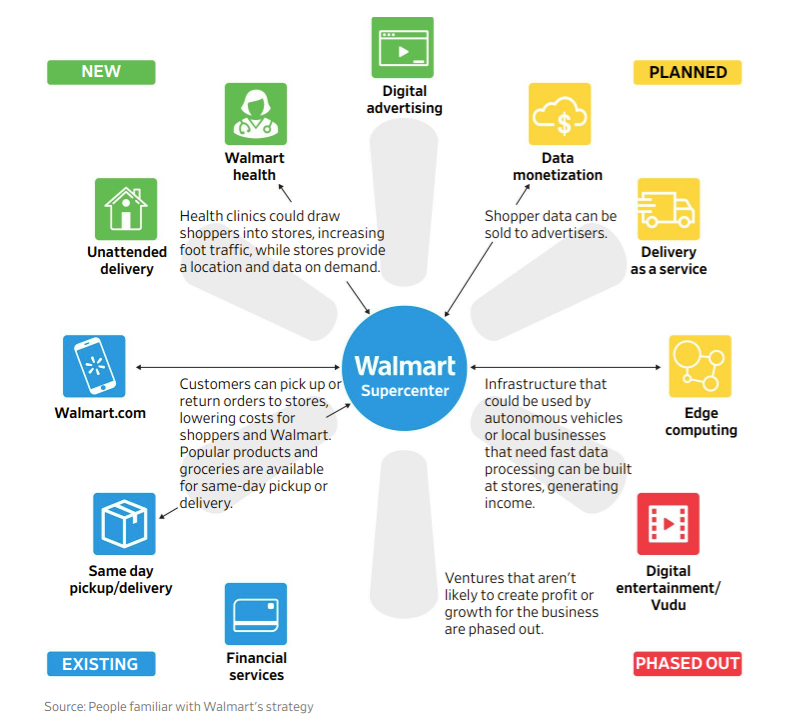
But other perhaps unexpected names will emerge. Already, Walmart, the giant U.S. retailer, now says it will build edge computing facilities available to third parties. Developments such as that show the challenges telcos will face in securing a role in edge computing. On the other hand, such hyper competition is not unique. Most big markets are susceptible to disruption.
For example, Walmart believes it must take a greater share of advertising, in part to sustain profitability of its online commerce operations.
Much as Amazon can pitch itself as a valuable ad venue because it knows what products people are searching for, right now, so Walmart hopes its shopper data can make it a place for advertising about related products after actual purchases have been made, for example.
The point is that Walmart might well be competing in a number of businesses we might not have expected. As it plans to make its edge computing services available to third parties, so Walmart now expects its own logistics capabilities to be offered to third parties.
Much hinges on how extensive an edge computing network must be, in a metro area, to support many classes of new applications requiring low latency. If, as many telco execs now believe, only one major metro edge computing site is required, competitive entry is easier for any number of new players.
If dispersed edge computing sites, with even lower latency are required for some use cases, then competitive entry is more difficult. It simply is not clear yet how extensive edge computing sites must be to support autonomous vehicles, for example.
Many observers would note that telcos often have stumbled trying to enter new fields where other providers--incumbent and upstarts--also have aspirations. It already looks like competitors in the edge computing market are moving fast, which could limit the revenue upside for telcos in the broader edge computing business.
Thursday, January 2, 2020
Will Multi-=Cloud Exist on the Edge?
It is not yet clear how the multi-cloud trend will shape the development of edge computing. But it seems clear there will be important impact. The percentage of enterprises that have a strategy to use multiple clouds is 84 percent (81 percent in 2018), while those planning a hybrid cloud strategy grew to 58 percent (51 percent in 2018), according to a survey of enterprises and smaller entities by RightScale, now owned by Flexera.

At least in principle, multi-cloud, applied to edge computing, might also require the existence of neutral host edge computing facilities.
How Much Could Edge Computing Contribute to Telco Recurring Revenue or Asset Monetization?
It remains to be seen whether connectivity providers will have more success in the edge computing colocation business than they seem to have had in the data center business. One might also argue that as telcos have not emerged as leaders in computing as a service, they have little chance to emerge as leaders of the edge computing as a service market, either.
With a few notable exceptions, such as NTT’s continuing support of its data center operations, data center units have proven irresistible assets to shed when cash can be wrung out of them to support other mission-critical telco business objectives.
At least in principle, edge computing colocation could be a logical line extension for many tier-one connectivity providers. The investments might be incremental, and the business might not be as easy or tempting to sell, when edge computing colo sites are inside telco facilities, for example.
The more-difficult asset monetization path might lead executives to commit more fully to the edge data facilities business, as it will not be so easy to sell those assets to raise cash. Cell towers and stand-alone data center facilities were easy to separate from the rest of the connectivity business.
That is not so easy when edge computing racks and infrastructure are inside telco buildings and real estate, unless those facilities have been nearly entirely replaced as elements of the communications infrastructure.
On the other hand, network virtualization could be a way for telcos to position much of their former central office infrastructure as non-core assets, though they might still need to become tenants, if most local central offices were sold. Much as they sell owned towers and then become tenants, the same could, in principle, be done with most central offices once virtualization is possible.
At least for fixed network operations, those former CO locations would still be needed as aggregation points for the local access network.
If an entire local access business cannot or should not be sold, the question might then be asked: how much of those physical “access” assets could be positioned for sale? Generally speaking, COs and access networks have been considered mission critical assets, with connectivity providers benefiting from ownership of those facilities.
So there are some possible new questions.
To what extent does edge computing infrastructure, like the data center business, create recurring revenue, and to what extent might such assets become mission critical for connectivity providers?
Even if mission critical, could such assets be packaged for possible eventual sale, using the same sale and lease-back mechanisms previously used for cell towers?
To the extent that edge computing is integral for connectivity service operations, to what extent could those functions be supplied as a “buy rather than build” input?
Those could become more interesting discussions at some point, as most service providers seek to become a bit more asset light, if only to reduce the sunk costs of their businesses.
Subscribe to:
Posts (Atom)