Monday, November 29, 2021

MEC Opportunities for Mobile Operators Might Vary from Region to Region

Multi-access Edge Computing, as envisioned by mobile operators, has been viewed as a way to leverage 5G to create a revenue-creating role in edge computing. To say it is complicated is to acknowledge the truth. Connectivity providers can supply the access and often real estate. 


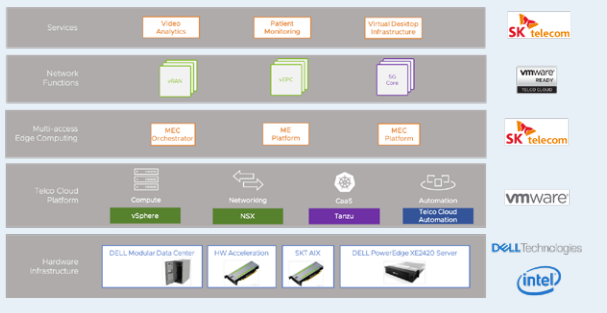
More complicated is the creation of a role in the actual computing as a service function. SK Telecom, for example, is creating its own branded MEC service, including the actual compute cycles and analytics; operations; vertical applications plus connectivity. 

source: RCR 


To do so it builds on Intel and Dell servers, VMware for compute cycles and computing-as-a-service management. SK contributes the connectivity, real estate and some vertical market solutions as well. 


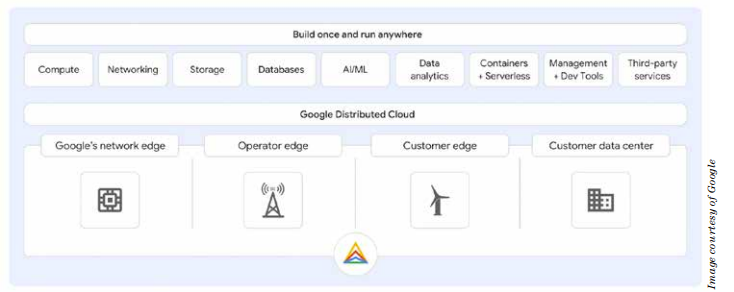
Another model involves mobile operators supplying connectivity and real estate, with a hyperscale computing-as-a-service supplier providing the actual compute cycles. 

source: RCR 


Some mobile operators are likely to try the former approach; others will choose the latter. Much could depend on the maturity of hyperscale cloud computing in different regions. Where cloud computing services are immature, there arguably are greater opportunities for a telco-developed role in providing edge computing. 


In markets where hyperscale cloud computing is well developed, there arguably are fewer opportunities for a mobile operator created edge computing services business.


"I'm 64, I Don't Know What the Cloud Is"


Tuesday, November 16, 2021

How Will Edge Change Data Traffic Patterns?

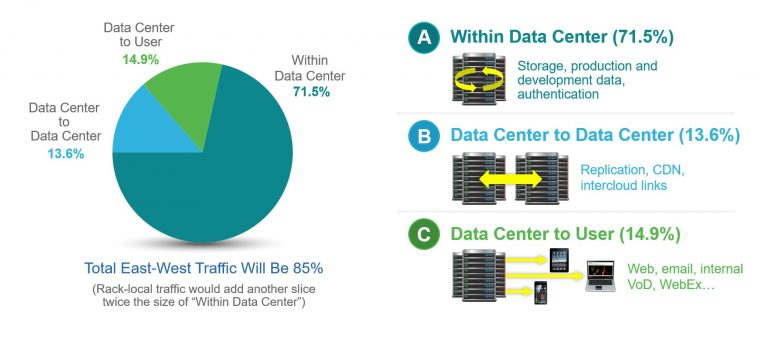
Data center and consumer end user data usage are virtually mirror images of each other: most end user data consumption involves remote server access, while most data center data consumption is based on other local servers. In other words, consumer data usage now is WAN centric, while data center demand is LAN centric. 


How those patterns might change once edge computing becomes ubiquitous is not yet clear. By definition, more computing and server access will come from a local source (on the premises or within a metro area) rather than from a remote data center.


Computation-focused operations (image analysis, virtual reality, augmented reality) will still rely on external server access, only those servers will be closer to the end user.


Many other content-related operations will rely on the existing metro data center architecture (content delivery networks), while highly-customized operations relying on large data stores will still happen msotly remotely.


The huge amount of “within the data center traffic” is partly caused by applications that involve lots of queries. Many internet applications are extremely “chatty”. A single search query within the data center might involve hundreds of server requests, for example. 


A social networking transaction has a similar multiplier effect, as it draws in an entire social graph to respond to a single query. 

source: Cisco 


The architecture of data centers can contribute to the amount of traffic as well, using with separate storage arrays, development or  production server pods and application server clusters that all need to talk to one another.


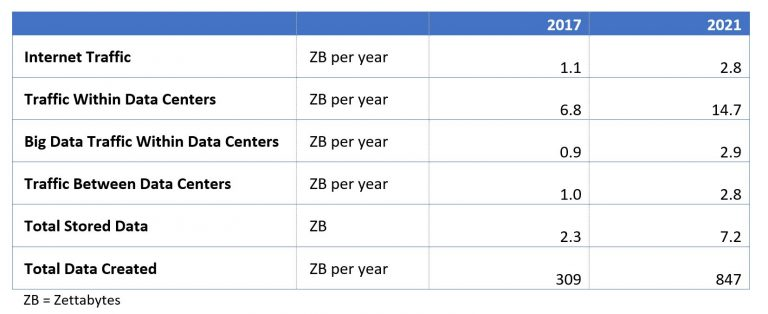
Data center traffic moving to end users was a decade ago a larger percentage of total wide area network data volume. That has been steadily changing, with more traffic moving between data center locations.  


source: Cisco 


In 2021, the volume of data moving between data centers is about equal to the amount of data moving to end users. Content caching accounts for some of the data center to data center increase. Content mirroring accounts for an additional amount of inter-data-center traffic. 

source: Cisco 


Still, wide area network bandwidth now is about equally composed of traffic heading for end users and traffic moving between data centers, a trend itself driven by the dominance of content as a driver of network capacity. 

source: Telegeography 


Content drives as much as 83 percent of transAtlantic traffic and 66 percent of transPacific traffic, for example. 

source: Telegeography 


Monday, November 15, 2021

Which Edges Will American Tower Pursue, After CoreSite Acquisition?

American Tower’s acquisition of data center provider CoreSite is intended to support American Tower’s edge computing ambitions. It is not yet clear how many of the multi-access edge computing segments the acquisition will support, at least initially. 


source: American Tower 


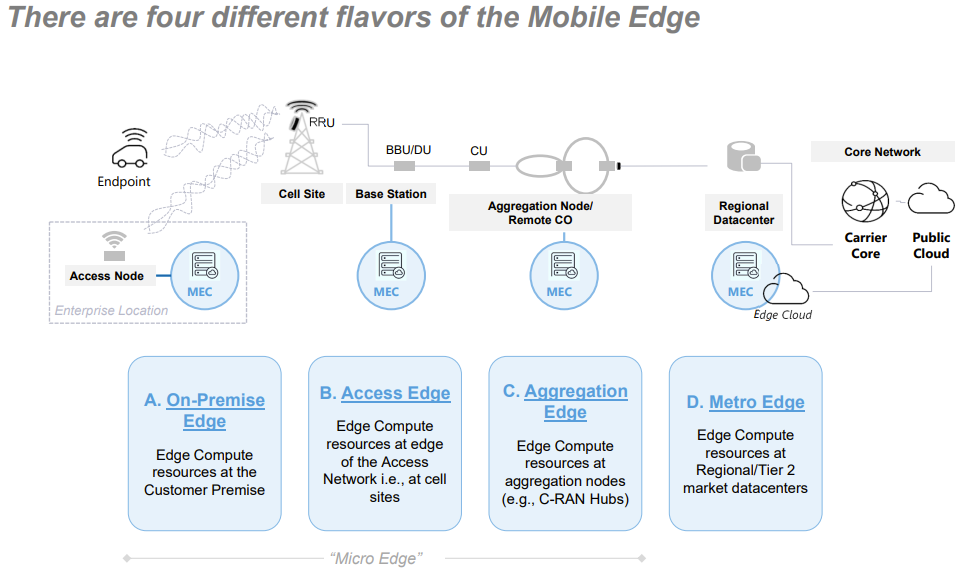
What might be most obvious are ways to support the access edge (tower sites), aggregation edge or regional data center (metro edge) venues.


Friday, November 12, 2021

Edge Computing Sales $17.8 Billion Globally by 2025

The sale of edge computing products, services and solutions will grow to reach US$17.8 billion in 2025, up from an estimated US$8 billion in 2019, at a compound annual growth (CAGR) rate of 15.6 percent, according to GlobalData.


As always, this forecast includes sales of infrastructure to create edge computing capabilities, system integration and installation, real estate investments, computing-as-a-service services and connectivity. 


In North America, sales of edge computing products, services and solutions will amount to US$6.85 billion by 2025, which is equivalent to 38 percent of the total global market. 


Sales in Asia Pacific and Western Europe will amount to US$4.65 billion and US$3.39bn, respectively, equivalent to 26.4 percent and 19.3 percent of the total global market, the firm estimates.


Tuesday, November 2, 2021

Metaverse Should Drive Edge Computing

The name change from Facebook to Meta illustrates why remote computing and computing as a service are driving computing to the edge. 


“The metaverse is a shared virtual 3D world, or worlds, that are interactive, immersive, and collaborative,” says Nvidia. 


Facebook says “the metaverse will feel like a hybrid of today’s online social experiences, sometimes expanded into three dimensions or projected into the physical world.”


As 3D in the linear television world has been highly bandwidth intensive, so are metaverse applications expected to feature needs for lots of bandwidth. As fast-twitch videogaming has been reliant on low latency response, metaverse applications will require very low latency. As web pages are essentially custom built for each individual viewer based on past experience, so metaverse experiences will be custom built for each user, in real time, often requiring content and computing resources from different physical locations. 


All of that places new emphasis on low latency response and high bandwidth computing and  communications network support. Multiverse experiences also will be highly compute intensive, often requiring artificial intelligence. 


As with other earlier 3D, television, high-quality video conferencing apps and immersive games, metaverse experiences also require choices about where to place compute functions: remote or local. Those decisions in turn drive decisions about required communications capabilities. 


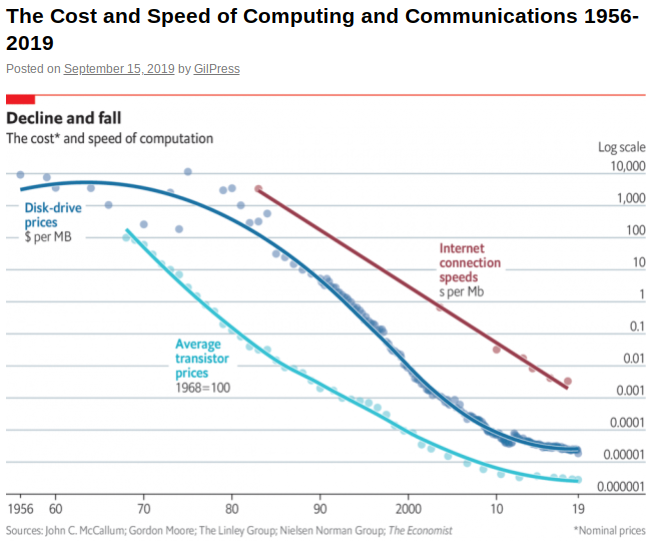
Those choices  always involve cost and quality decisions, even as computational and bandwidth costs have fallen roughly in line with Moore’s Law for the last 70 years. 


source: Economist, Whats the Big Data


As low computational costs created packet switching and the internet, so low computational costs support remote and local computing. Among the choices app designers increasingly face are the issues of latency performance and communications cost. Local resources inherently have the advantage for latency performance and also can be a material issue when the cost of wide area bandwidth is added. Energy footprint also varies (local versus remote computing).  


On the other hand, remote computing means less investment in local servers. The point is that “remote computing plus wide area network communications” is a functional substitute for local computing, and vice versa. When performance is equivalent, designers have choices about when to use remote computing and local, with communications cost being an integral part of the remote cost case. 


Metaverse use cases, on the other hand, are driven to the edge (local) for performance reasons. Highly compute-intensive use cases with low-latency requirements are, in the first instance, about performance, and then secondarily about cost. 


In other words, fast compute requirements and the volume of requirements often dictate the choice of local computing. And that means metaverse apps drive computing to the edge. 


source: Couchbase

Why "Ecosystem" has Grown in Importance for Data Centers

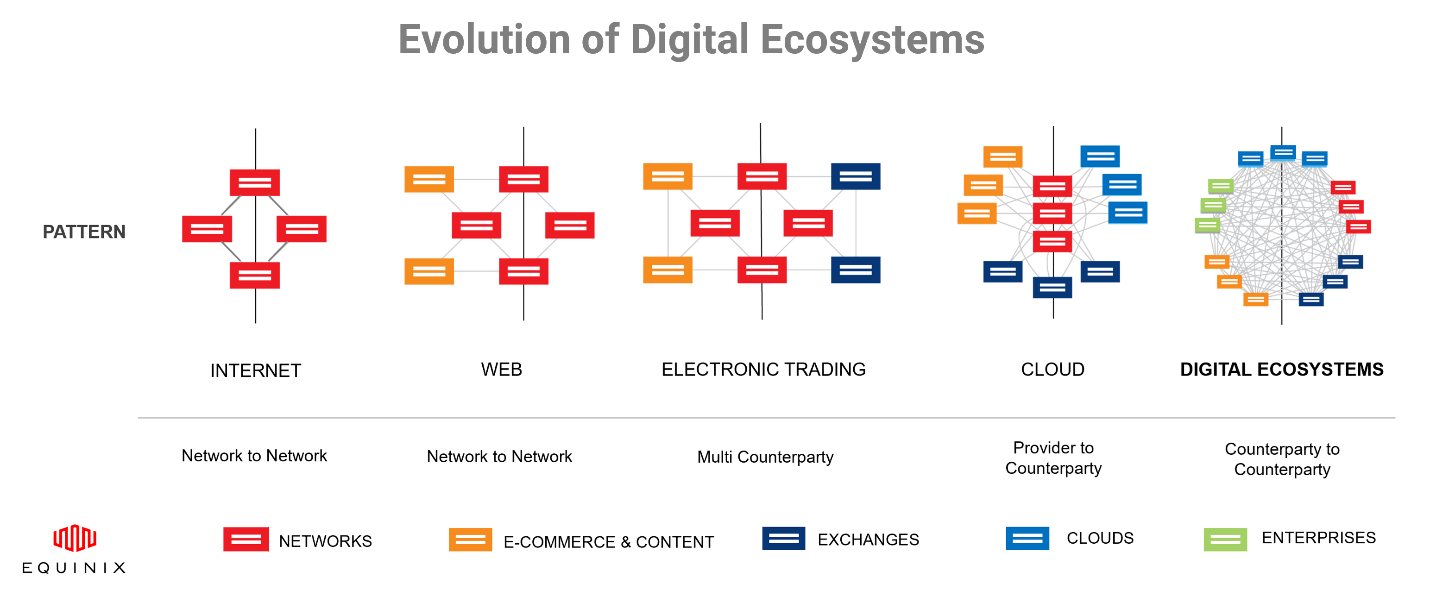
The data center and  interconnection markets have changed over the past couple of decades. Early on, it was connectivity providers that needed to interconnect their networks. With the internet, new requirements were created for internet service providers and internet transport providers to connect to each other. 


Now application providers often must connect with other app providers and connectivity providers. All that is why there is a growing emphasis on “ecosystems” in the data center collocation market. 


source: Canalys 


As service provider interconnection drove the business model for older business models, over time additional interconnection participants have emerged, including application, platform and content providers. In some cases, the newer participants are engaged in direct counterparty trades between themselves. 

source: Equinix 


Monday, November 1, 2021

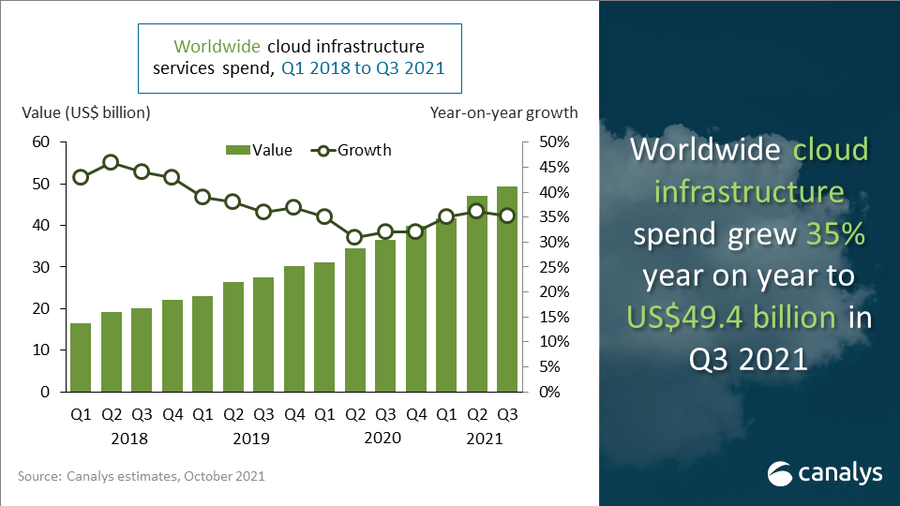
Cloud Infrastructure Service Revenue Grew 35% in 3Q 2021, Says Canalys

Global spending on cloud infrastructure services increased 35 percent in the third quarter of 2021 to reach US$49.4 billion for the quarter, and implying full-year revenue for cloud infrastructure service providers in the range of $185 billion or so. 


source: Canalys 


Canalys defines cloud infrastructure services as those that “provide infrastructure as a service and platform as a service, either on dedicated hosted private infrastructure or shared infrastructure.”


One source of possible definitional difference is how to count “application as a service” revenue, particularly important when evaluating Microsoft, Oracle or IBM figures, for example. 


Canalys says it excludes the value of  “software as a service”, but includes revenue generated from the infrastructure services being consumed to host and operate them.


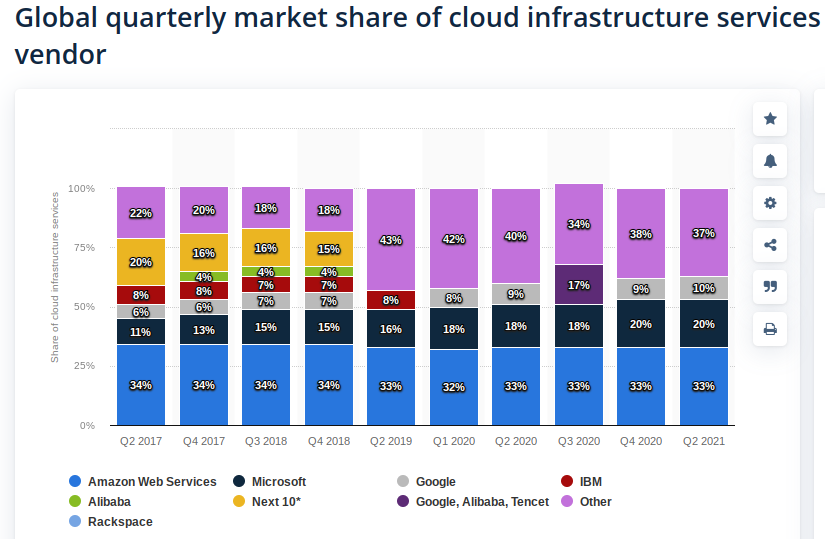
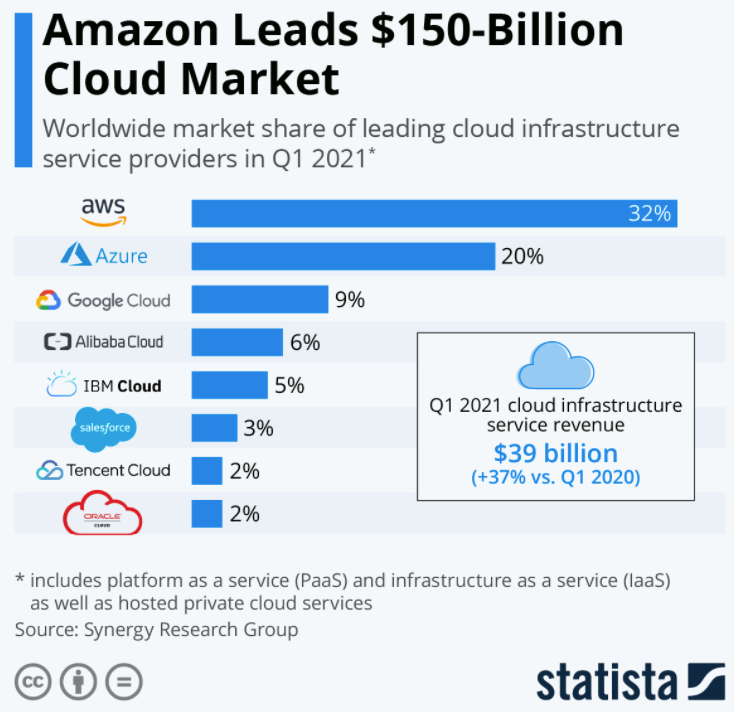
Other analyses tend to confirm the Canalys market share figures, which rank Amazon Web Services with 32 percent market share; Microsoft Azure at 21 percent and Google Cloud at eight percent share. 


source: Statista


sources: Synergy Research Group, Statista

Tuesday, October 26, 2021

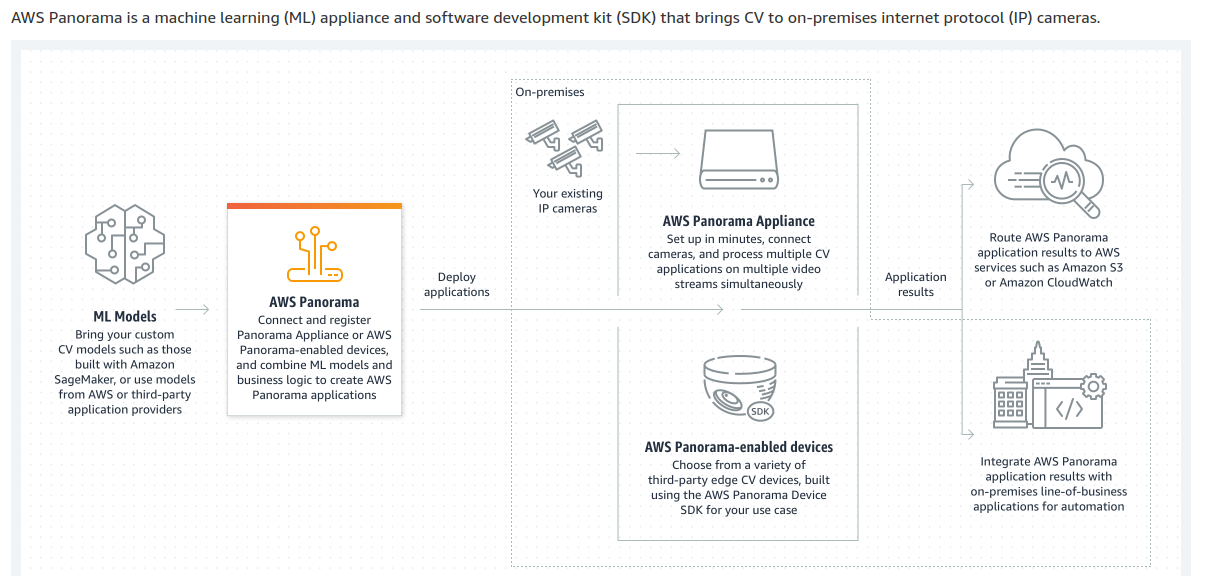
AWS Panorama Illustrates Several Trends

AWS Panorama neatly illustrates a few key trends in computing: edge computing; distributed computing; artificial intelligence and digital transformation. 


AWS Panoramais a new machine learning appliance and software development kit allowing organizations to bring computer vision (CV) to their on-premises cameras to make automated predictions on the spot, with high accuracy and low latency, without human intervention. 


The AWS Panorama Appliance is a hardware device installed on a local surveillance camera system network. Panorama connects to existing cameras within a facility to run multiple computer vision models on concurrent video streams, providing analysis that otherwise would have to be performed manually by humans, with locally or remotely. 


source: AWS 


The AWS Panorama Appliance value can come in various ways beyond local image analysis and pattern recognition. Panorama adds value where low-latency recognition is important and remote processing takes too long. 


In other cases, where data privacy is required, it may not be desirable to send information across the internet or wide area networks. In other cases, local internet access bandwidth might be limited or episodic, requiring local processing for continuity. 


In yet other cases, the savings in WAN bandwidth charges also add value. 


With AWS Panorama, companies can use compute power at the edge  (without requiring video streamed to the cloud) to improve their operations. 


Panorama automates monitoring and visual inspection tasks like evaluating manufacturing quality, finding bottlenecks in industrial processes, and assessing worker safety within their facilities. These methods are manual, error prone, and difficult to scale.


Sunday, October 24, 2021

AWS Outposts: Cloud Giant's Edge Solution


Beyond local compute, AWS Outposts might also raise the issue of preferred or necessary premises connectivity platforms. does cable Ethernet suffice? Does Wi-Fi work? How about other short-range connectivity choices? For which use cases is 5G helpful? And are the economics of using public 5G okay? Is private 5G helpful? 

Saturday, October 23, 2021

How Big Will Edge Computing Be for Mobile Operators?

Edge computing is viewed as a promising new revenue opportunity by connectivity and computing industry observers and service provider executives alike.


“Computing as a service” suppliers and data centers see a huge transition of computing architecture towards the edge, with an obvious need to craft strategies positioning them for that transition. 


The general shift of computing architecture towards distributed computing is driven by a belief that intensive artificial intelligence use cases involving real-time or near-real-time processing of vast amounts of data, will drive that move to local computing. That obviously affects the computing as a service market. 


Connectivity providers see upside as well. Potential new uses are seen for 5G networks as the connectivity mechanism for much edge computing, especially support of ultra-low latency use cases of various types, ranging from vehicle control and services to factory automation and beyond. 


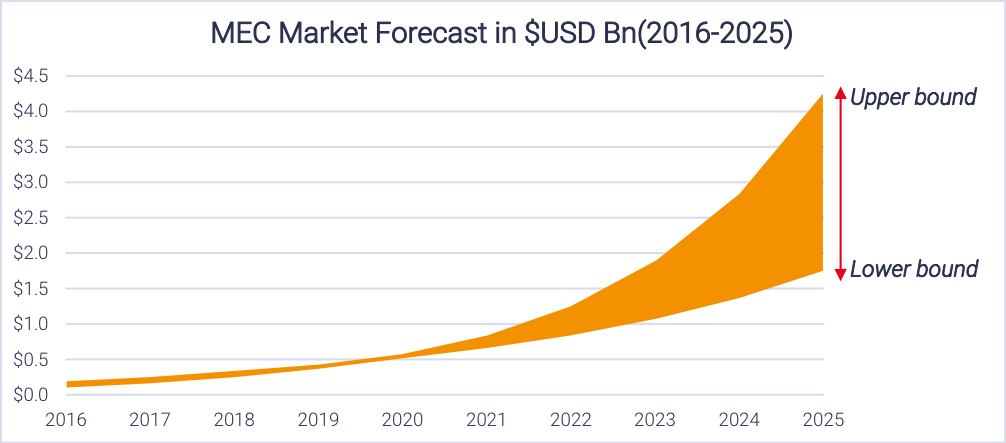
The issue is “how big” the revenue upside might be, for computing and connectivity providers. We cannot tell much right now, as edge computing service revenues are too small to note. Nor can we determine the ultimate range of roles connectivity providers might assume. 


Right now, all revenue earned by all connectivity providers in any way connected directly with edge computing is quite small, by global standards. Basically, access providers might have roles as real estate providers (racks, huts, space); connectivity providers (5G and fixed); actuall suppliers of compute services; system integrators; platform providers or application providers. 

source: STL Partners  


Connectivity providers might hope to operate as the actual providers of edge computing services (compute cycles, for example). More complicated roles as platforms are feasible. Most complex of all are applications that might be created and owned by the connectivity provider. Simplest are traditional connectivity services roles. 


The point is that there are many ways edge computing could benefit access providers. 


Beyond that, a more distributed “public” computing architecture means much more localized or regionalized computing than has been the case for “cloud” computing. That might increase the importance of local access, even if it diminished some need for wide area network connections. 


There are real estate implications as well, as the focus shifts to localized data center facilities instead of remote hyperscale data centers. Telcos rightly see new uses for their existing local real estate assets. 


source: AWS 


Other avenues of interest exist because 5G network slicing creates opportunities for private networks (wide area or local area) with customized performance characteristics, either as a complement to or a replacement for edge computing. 


Almost counter intuitively, edge computing eliminates the need to use wide area network capacity to move data to remote locations for processing. In fact, local processing long has been a substitute for transmission.  


If edge computing essentially is a functional substitute for remote processing that uses wide area networks, then perhaps a telco should play a role in the revenue-producing part of edge computing, to profit from either choice (local or remote processing). 


There also are new drivers for private 5G networks to support edge computing infrastructures, an area where system integrators should have an edge, but where opportunities also exist for mobile operators to act as the integrators or operators of infrastructure. 


It also is hard to escape the notion that because 5G networks are distributed and virtualized, telco 5G networks must themselves use edge computing. There is something at work here that suggests the infrastructure built for “our own use” might also be commercialized “as a service” for third party customers. 


Perhaps, in the end, edge computing might be as important as an input to the 5G business as a product telcos help produce.
Saturday, October 16, 2021

Edge Revenues Too Small to Enumerate, Right Now

Edge computing "as a service" is among the big carrot for internet service providers intrigued by multi-access edge computing. To be sure, incremental 5G connection revenues will matter, as will some incremental real estate revenue (providing the edge computing racks, air conditioning, power, secured locations).


But most of the new revenue will come from the actual computing services, provided privately, as infrastructure (enterprises deploying owned infrastructure) or publicly, in the form of X as a service.


The issue is how much revenue upside exists for most connectivity providers. Today it is almost meaningless to break out "edge" computing as a category. That will change over time.


Worldwide end-user spending on public cloud services is forecast to grow 23.1 percent in 2021 to total $332.3 billion, up from $270 billion in 2020, according to Gartner. Key trends include containerization, hybrid cloud, multi-cloud, internet of things and edge computing, as you would guess. 


Worldwide Public Cloud Services End-User Spending Forecast US$ Billions


2020

2021

2022

Cloud Business Process Services (BPaaS)

46,131

50,165

53,121

Cloud Application Infrastructure Services (PaaS)

46,335

59,451

71,525

Cloud Application Services (SaaS)

102,798

122,633

145,377

Cloud Management and Security Services

14,323

16,029

18,006

Cloud System Infrastructure Services (IaaS)

59,225

82,023

106,800

Desktop as a Service (DaaS)

1,220

2,046

2,667

Total Market

270,033

332,349

397,496

BPaaS = business process as a service; IaaS = infrastructure as a service; PaaS = platform as a service; SaaS = software as a service

source: Gartner