Sunday, December 8, 2019

Thursday, December 5, 2019
Hyperscale Data Centers Begin Move to the Edge
Alphabet, Alibaba, Amazon, Apple, Baidu, Facebook, Microsoft, Rakuten and Tencent, which operate the biggest hyperscale data centers, also now are making initial moves to “own the edge” as well. Though in 2019 they might collectively spend about five percent of total capex on edge computing, by 2023 they could be devoting as much as 50 percent of capex on edge computing, according to a forecast by Technology Business Research.

AWS Launches 3 Separate Edge Computing Initiatives
AWS is making its edge computing strategy clearer, launching several initiatives. AWS Wavelength embeds AWS compute and storage services within telecommunications provider data centers at the edge of the 5G networks.
AWS Local Zone extends edge computing service by placing AWS compute, storage, database, and other select services closer to large population, industry, and IT centers where no AWS Region exists today.
AWS Local Zones are designed to run workloads that require single-digit millisecond latency, such as video rendering and graphics intensive, virtual desktop applications. Local Zones are intended for customers that do not want to operate their own on-premises or local data center.
Likewise, AWS Outposts puts AWS servers directly into an enterprise data center, creating yet another way AWS becomes a supplier of edge computing services. “AWS Outposts is designed for workloads that need to remain on-premises due to latency requirements, where customers want that workload to run seamlessly with the rest of their other workloads in AWS,” AWS says.
AWS Outposts are fully managed and configurable compute and storage racks built with AWS-designed hardware that allow customers to run compute and storage on-premises, while seamlessly connecting to AWS’s broad array of services in the cloud.
AWS Makes New Moves in Edge Computing
Mobile operator executives continue to believe that “disruptive competition” from over-the-top app providers is the single greatest business challenge they face. In a sense, that should also prove to the case as edge computing develops.

It remains unclear how the “edge computing as a service” develops. It likewise remains unclear what roles connectivity providers might play, although tier-one service providers hope they can themselves become suppliers of edge computing as a service.
But there will be competition for that role.
AWS Local Zone, for example, is an edge computing service directly available to enterprises. Likewise, AWS Outposts puts AWS servers directly into an enterprise data center, creating yet another way AWS becomes a supplier of edge computing services.
AWS Local Zones for Edge Computing Advantages
Amazon Web Services Inc. (AWS) has announced Local Zones, a new type of AWS infrastructure deployment that places compute, storage, database, and other select services close to customers, giving developers the ability to deploy applications that require single-digit millisecond latencies to end-users, AWS says.

AWS Local Zones place AWS compute, storage, database and other select services closer to large population, industry, and IT centers where no AWS Region exists today.
AWS believes the new zones will find use cases in media & entertainment content creation, real-time gaming, reservoir simulations, electronic design automation, and machine learning.
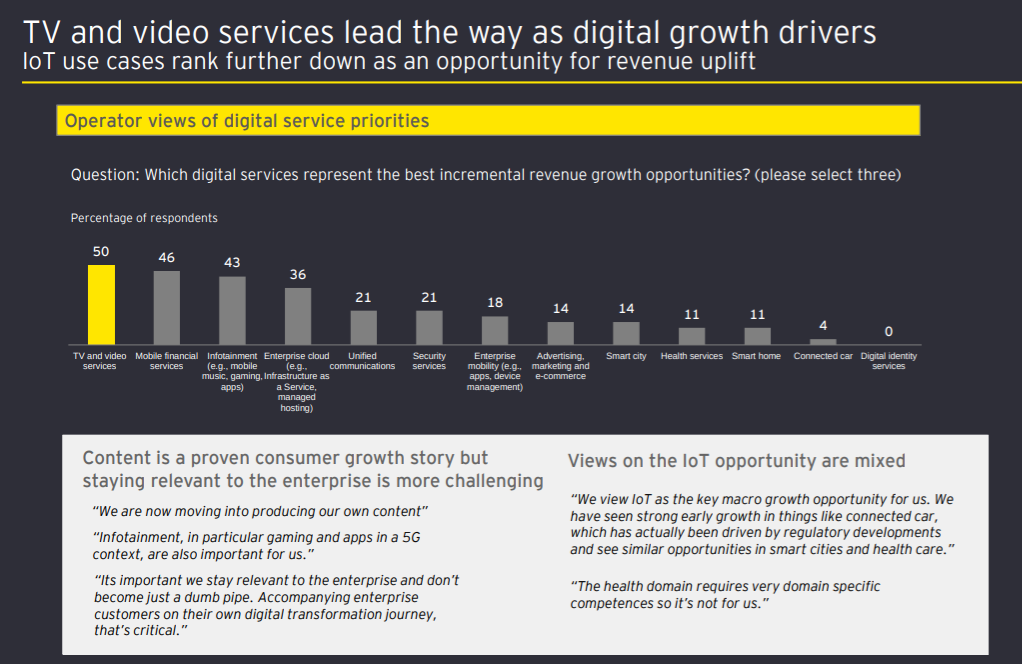
36% of Mobile Execs Seen Cloud Computing (Edge) as a Growth Driver
It should not be surprising that mobile service provider executives in 2019 view entertainment and content services as key revenue growth drivers. That is a trend under way for some time, is a large market with proven demand, and has successfully been pioneered.
Edge computing and internet of things use cases are yet developing, a survey by EY finds. That should change, over time, as proven use cases and revenue models develop.
Tuesday, December 3, 2019
AWS Goes to the Edge
Amazon Web Services Inc. (AWS) has announced AWS Wavelength, which provides developers the ability to build applications that serve end-users with single-digit millisecond latencies over a 5G network.
Wavelength embeds AWS compute and storage services at the edge of telecommunications providers’ 5G networks, enabling developers to serve use-cases that require ultra-low latency like machine learning inference at the edge, autonomous industrial equipment, smart cars and cities, Internet of Things (IoT), and Augmented and Virtual Reality.
AWS customers can now use the same familiar AWS APIs, tools, and functionality they use today, to deliver-low latency applications at the edge of the 5G network, around the world, AWS says.
AWS is partnering with Verizon, Vodafone, SK Telecom, and KDDI) to launch AWS Wavelength across Europe, South Korea, and Japan in 2020, with more global partners “coming soon,” AWS says.
Verizon Partners with AWS for Edge Computing
It was probably inevitable that Verizon is partnering with Amazon Web Services for edge computing after AT&T and Microsoft announced their partnership for 5G-enabled edge computing.
Though each telecom giant is pursuing edge computing, the choice of a different strategic partner is a pattern with a long history, as doing so creates some amount of differentiation in the offers each can create.
Verizon, says Amazon, is the first technology company in the world to offer 5G network edge computing, and will use AWS’s new service, AWS Wavelength, to provide developers the ability to deploy applications that require ultra-low latency to mobile devices using 5G.
The companies say they are currently piloting AWS Wavelength on Verizon’s edge compute platform, 5G Edge, in Chicago for a select group of customers, including video game publisher Bethesda Softworks and the National Football League.
AWS and Verizon say the partnership brings “processing power and storage physically closer to 5G mobile users and wireless devices, and enable developers to build applications that can deliver enhanced user experiences like near real-time analytics for instant decision-making, immersive game streaming, and automated robotic systems in manufacturing facilities.”
AT&T calls its platform “Network Edge Compute,” which weaves Microsoft Azure cloud services into AT&T network edge locations closer to customers. That means AT&T customers will be able to use Azure services at the edge.
Monday, December 2, 2019
AI Seen as Driving Edge Computing
Support for artificial intelligence processes is among the biggest benefits organizations seek from edge computing. Reducing latency is the other key expected benefit, according to Forrester Research. In 2018, the stated value was more support for internet of things apps.
Edge computing was on the 2018 agenda, seems to be on the 2019 agenda and undoubtedly will also be on the 2020 agenda. “Fifty seven percent of mobility decision makers surveyed in the Forrester Analytics Global Business Technographics® Mobility Survey, 2019, said they have edge computing on their roadmap for the next 12 months,” Forrester Research says.
Keeping in mind that the market is quite young, Forrester Research predicts that the edge cloud services market will grow by at least 50 percent in 2020. The main effort will be to supply basic infrastructure-as-a-service (IaaS) and advanced cloud-native programming services on distributed edge computing infrastructure, according to Forrester.
The goal is to enable IaaS and platform-as-a-service (PaaS) services that run independently of or with only intermittent connectivity to public cloud and data center assets. That implies substantial “compute at the edge” capabilities, as apps will have to be architected to run locally, with periodic remote data center support.
Wednesday, November 27, 2019
AT&T, Microsoft Trialing Edge Computing
AT&T’s software-defined and virtualized 5G core now is capable of delivering Microsoft Azure services, and AT&T is making the capabilities available for a limited set of select customers in Dallas. Next year, Los Angeles and Atlanta are targeted for select customer availability.
The move is part of AT&T’s pursuit of edge computing opportunities. Through AT&T Foundry, AT&T and Microsoft are exploring proofs-of-concept including augmented and virtual reality scenarios and drones.
For example, both companies are working with Israeli startup Vorpal, helping its VigilAir product track drones in commercial zones, airports, and other areas with near-instant positioning.
The companies also recently demonstrated the use of Microsoft HoloLens to provide 3D schematic overlays for technicians making repairs to airplanes and other industrial equipment.
5G Embedded and Edge Solutions
Bryan Jones, Dell Technologies SVP & GM, OEM | Embedded & Edge Solutions
Monday, November 25, 2019
From Pipes to Platforms?
At least some mobilke service providers fond hope that edge computing could eventually become a platform for connectivity service providers, generating new revenues beyond data processing services, as helpful as that would be.
In fact, the ability to generate revenue from acting as an intermediary or marketplace for different sets of market participants is the functional definition of whether some entity is a platform, or not.
That can be glimpsed in service provider video subscription businesses, where revenue is earned directly from subscribers, but also from advertisers and in some cases from content suppliers. It is the sort of thing eBay must do, daily, in a more direct way.
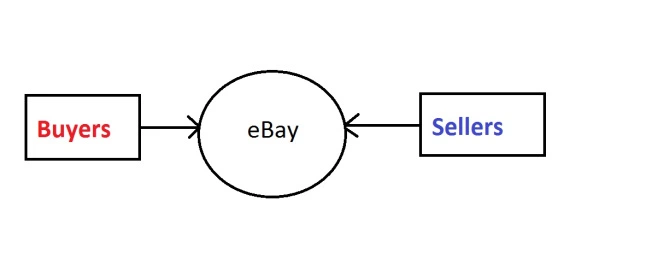
But it seems logical to predict that few such platform opportunities will emerge early and directly. Instead, the more likely path is that some initial direct product sold to one type of customer becomes the foundation for creation of the marketplace or platform.
The first million people who bought VCRs bought them before there were any movies available to watch on them. That might strike you as curious, akin to buying a TV when there are no programs being broadcast.
In fact, though commercialized about 1977, it was not firmly legally established that sales of VCRs were lawful until 1984, when the U.S. Supreme Court ruled that Sony could sell VCRs without violating copyright law, as Hollywood studios alleged.
So what were those people doing with their VCRs? Taping shows to watch later. Time shifting, we now call it. Only later, after Blockbuster Video was founded in 1985, did video rentals become a mass market phenomenon.
So here is the point: quite often, a new market is started one way, and then, after some scale is obtained, can develop into a different business model and use case.
Once there were millions of VCR owners, and content owners lost their fear of cannibalizing their main revenue stream (movie theater tickets), it became worthwhile for Hollywood to start selling and renting movies to watch on them.
Eventually watching rented movies became the dominant use of VCRs, and time shifting a relatively niche use.
That strategy might be called stand-alone use, creating a new market by directly satisfying a customer need, before a different two-sided or multi-sided market can be created, where at least two distinct sets of participants must be brought together, at the same time, for the market to exist. Virtually any online marketplace is such a case.
Others might call it single-player. OpenTable, which today has a marketplace revenue model, originally only provided a reservation system to restaurants, operating in a single-sided market mode, before it then could create a two-sided model where restaurants pay money for the booked reservations made by consumers.
So OpenTable, which operates in a two-sided marketplace--connecting restaurants and diners--started out selling reservation systems to restaurants, before creating its new model of acting as a marketplace for diners and restaurants.
The extent to which that also will be true for some internet of things platforms is unclear, but likely, even for single-sided parts of the ecosystem.
The value of any IoT deployment will be high when there is a robust supply of sensors, apps, devices and platforms. But without many customers, the supply of those things will be slow to grow, even in the simpler single-player markets. Just as likely, though, is the transformation of at least some of the single-player revenue models to two-sided marketplaces.
In other words, a chicken-and-egg problem will be solved by launching one way, then transitioning to another, more complicated two-sided model requiring scale and mutual value for at least two different sets of participants. In a broad sense, think of any two-sided market as one that earns revenue by creating value for multiple sets of participants.
Amazon makes money from product sellers and buyers, while at the same time also earning revenue from advertisers and cloud computing customers.
Telcos have faced this problem before.
Back in the 1870s and 1880s, when the first telephone networks were created, suppliers faced a severe sales problem. The value of the network depended on how many other people a customer could call, but that number of people was quite small. The communications service has a network effect: it becomes more valuable as the number of users grows.
These days, that is generally no longer the case. The number of people, accounts and devices connected on the networks is so large that the introduction of a new network platform does not actually face a network issue. The same people, devices and accounts that were connected on the older platform retain connectivity while the new platform is built.
There are temporary supply issues as the physical facilities are built and activated, but no real chicken and egg problem.

The point is that at least some internet of things or other new services ventures attempted by telcos will eventually require the building of a marketplace of some sort providing value to multiple sets of participants.
The video entertainment business already provides an example, where service providers earn direct subscription fees from viewers, but also advertising revenues from third parties.
In some cases, where content subscription providers also own content assets, they may earn revenue from content licensing to other third party distributors as well.
It remains to be seen whether some connectivity providers also will be able to create multi-sided markets for internet of things or other new industries. There are potential opportunities around edge computing, for example.
The initial value might simply be edge data center functions. Later, other opportunities could arise around the use of edge computing, the access networks, customer bases and app providers. It would not be easy; it rarely is. But creating new revenue streams for some customers who just want edge computing cycles could create foundation for other revenue streams as well.
Friday, November 22, 2019
Some Apps Moving Back from Cloud to Premises
While applications with unpredictable usage may be best suited to the public clouds offering elastic resources, workloads with more predictable characteristics can often run on-premises at a lower cost than public cloud, a study by Nutanix suggests.
As a result, many organizations plan to move at least some applications back away from the cloud and back on premises. Some 73 percent of respondents reported that they are moving some applications off the public cloud and back on premises.
While 37 percent of enterprise workloads are running in some type of cloud today, some applications seem candidates for moves back in house:
* desktop and application virtualization
* customer relationship management
* enterprise resource planning
* data analytics and business intelligence
* databases
* development and testing
* data backup and recovery
About 22 percent of those users are moving five or more applications back in house.
Savings are also dependent on businesses’ ability to match each application to the appropriate cloud service and pricing tier. Since plans and fees change frequently, enterprises and organizations must “remain diligent about regularly reviewing service plans and fees.”
That also suggests the importance of a multi-cloud strategy, to avoid lock-in. Fully 95 percent of survey respondents suggested it is essential or desirable to be able to easily move applications between cloud environments.
Security remains the biggest single issue related to further cloud decisions. Some 60 percent of respondents said that the state of security among clouds would have the biggest influence on their plans.
Also, data security and compliance were listed by 26 percent of respondents as the top concerns for deciding where an enterprise runs a given workload.
The survey also suggests the shift to some use of cloud computing continues. About 24 percent of respondents are not using cloud computing. In perhaps a year, the number of enterprises with no cloud deployments will plummet to seven percent.

In two years, the “no cloud” percentage might drop to three percent.
Subscribe to:
Posts (Atom)