Thursday, September 12, 2019

AI and Machine Learning for Taming Data Deluge

As disparate apps proliferate in enterprise environments, so have the number of uncorrelated data sources, the sheer amount of data produced and the number of false alarms and operational problems whose causes are opaque.

Visibility is the big problem AIOps attempts to remedy. Operations teams often cannot correlate data from multiple monitoring systems. Today, the objective is prediction, not simply observation; application performance, not simply hardware status; the ability to ingest and make sense of apps that produce huge volumes of data. 

Two decades ago, for example, operations staff could not monitor an app server's performance inside a Java virtual machine (JVM).

Today, the issue is resiliency and performance issues of containerized microservices, analysts at Forrester say. 

AIOps applies artificial intelligence, machine learning or other advanced analytics to business and operations data, providing correlations, prescriptive and predictive answers in real time. 

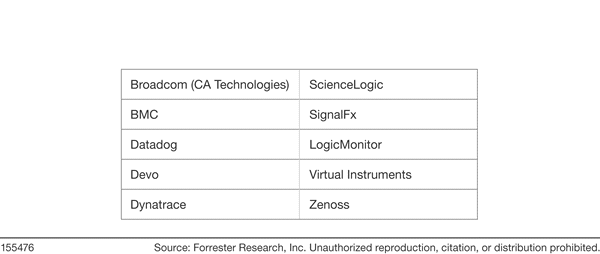
Enterprise monitoring solutions using an AIOps approach include CA Technologies, Zenoss and others, Forrester notes. 

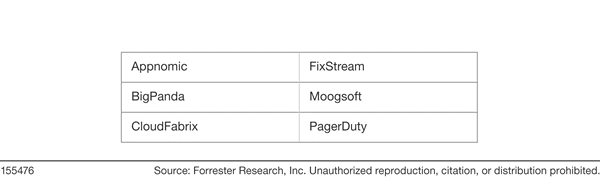
Intelligent analytics overlay apps provided by firms such as BigPanda, FixStream, and Moogsoft have developed solutions that provide an intelligent overlay of AI or ML algorithms that ops teams can apply across multiple monitoring solutions. 


Wednesday, September 11, 2019

Multi-Cloud Grows Because Enteprises Want to Avoid Vendor Lock-In

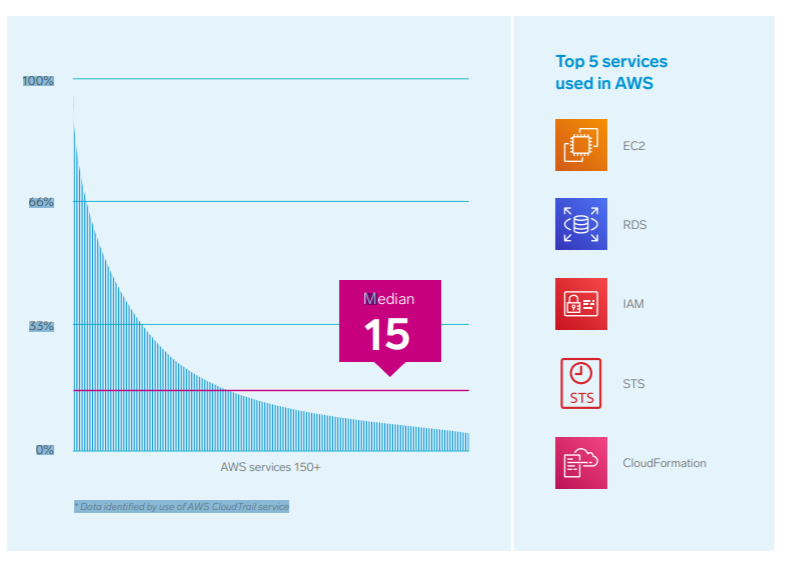
Multi-cloud computing is a fast-growing trend for obvious reasons: enterprises want to avoid vendor lock-in. A recent survey by Sumo Logic found that the typical AWS customer buys 15 AWS services out of a possible 150. 


That, in turn, drives adoption of Docker and Kubernetes, the survey suggests. 


Fewer than 10 percent of AWS services are broadly adopted by the majority of customers, the survey found.  Basic compute, storage, database, network, and identity services make up the top 10 adopted services in AWS.

Enterprise IT Managers Say AIOps Works

AIOps platforms enhance IT operations by combining big data, machine learning and visualization to create actionable insights. The top use cases for AIOps tools include intelligent alerting (69 percent), root cause analysis (61 percent), and anomaly detection (55 percent), according to one survey conducted for OpsRamp. 

The survey found the three biggest advantages of using AIOps tools are productivity gains from the elimination of low-value, repetitive tasks across the incident lifecycle (85 percent), rapid issue remediation with faster root cause analysis (80 percent), and better infrastructure performance through reduction in incident and ticket volumes (77 percent). 

With modern machine learning technologies, 40 percent of organizations fixed incidents 26 percent-50 percent faster, 37 percent reduced mean time to resolve by 51 percent to 75 percent while 10 percent brought down overall incident resolution times by more than 76 percent, OpsRamp says. 

Compared to more traditional monitoring tools, AIOps seeks to reduce noise (false alarms or redundant events), capture anomalies on a dynamic basis, provide a better causality trail, to help identify incident causes, then extrapolate to future events and take actions to resolve problems, either automatically or with IT staff approval.

AIOps Platforms Gaining Traction

AIOps platforms enhance IT operations by combining big data, machine learning and visualization to create actionable insights. 

Compared to more traditional monitoring tools, AIOps seeks to reduce noise (false alarms or redundant events), capture anomalies on a dynamic basis, provide a better causality trail, to help identify incident causes, then extrapolate to future events and take actions to resolve problems, either automatically or with IT staff approval. 


A sampling of AIOps platforms would include a large number of firms, ranging from Anodot to VuNet. These suppliers have the ability to ingest data from multiple sources, including historic and real-time streaming, and/or have different offerings that include proprietary, open source, free and commercialized versions, including deployment that cuts across on-premises and SaaS-based options.


AIOps platforms have historically focused on a single data source like logs or metrics. New data stores include digital experience data, order data, sentiment data from social media, service desk requests and statuses and account activity. 


Will 5G, Edge Computing or Custom and Private Networks Have Most Value for Enterprises?

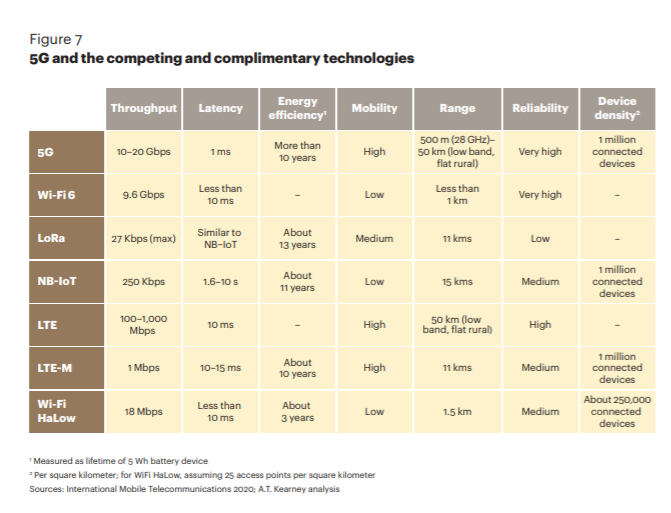
5G represents potential enterprise revenue upside, but only if 5G proves more attractive than other connectivity options, some based on 4G, others supplied by rival platforms using unlicensed spectrum. 

And it remains to be seen whether network slicing to create custom networks, 5G best effort access, private 5G networks or edge computing prove to have the highest value for enterprise buyers. Different use cases might rely on one or another of those attributes as the value driver. 

In fact, 5G access, in and of itself, might prove to be less a driver than the other features (customized networks, edge computing). And in some countries, private 5G networks will not create a new wholesale opportunity for mobile service providers, as enterprises will be able to use new spectrum specifically allowing them to create private 5G networks on their own.

Friday, September 6, 2019

HPE Outlines Most Attractive Mobile Edge Computing Use Cases

Hewlett Packard Enterprise believes there are many edge computing use cases where 5G network access will play a key enabling role, though enterprise use cases might not require 5G at all. 

HPE has cataloged more than 200 potential use cases in five categories: consumer services, enterprise AR/VR, enterprise analytics, IoT and subscriber services. 

The most-attractive retail use cases for 5G-enabled edge computing range from delivery of high-definition content and artificial reality or virtual reality to smart cities, drone control and autonomous driving. 


Wednesday, September 4, 2019

IoT Connectivity Revenues $2.6 Billion by 2024

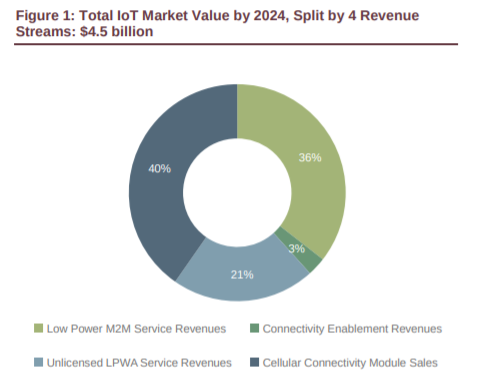
A new study from Juniper Research predicts that service provider revenues from connecting low power IoT devices will exceed $2.6 billion by 2024; growing from $290 million in 2019, representing an 800 percent increase over the next five years. 

Low power IoT technologies include low-priced wireless connections that deliver low bandwidth and power saving features suited to asset monitoring.

Juniper analysts predict that low power IoT connections supplied by mobile operators will reach 156 million by 2024, up from four million in 2019. 

Networks using an unlicensed spectrum, such as Sigfox and LoRa, will provide 160 million connections by 2024.


Industrial IoT Deployment is High, Edge Computing Deployment Low

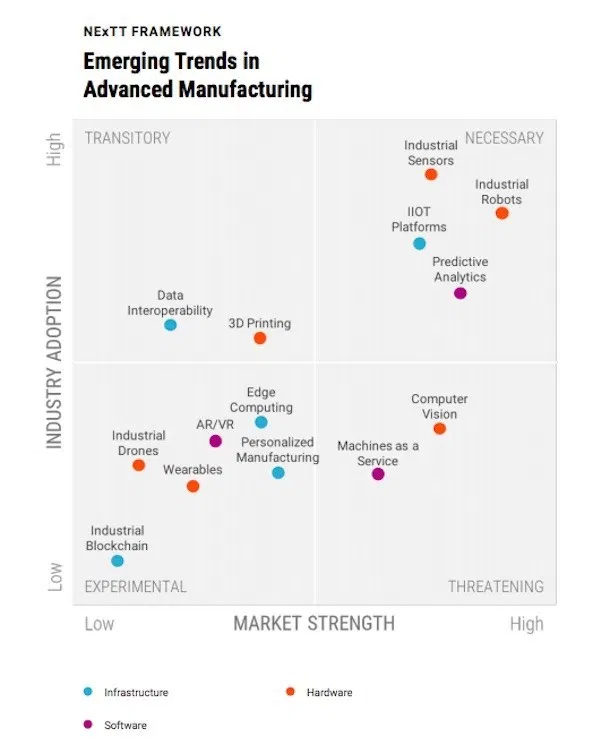
Industrial sensors, robots, industrial internet of things platforms and predictive analytics are in high deployment mode right now in the manufacturing segments of industry, according to CB Insights. The caveat is that CB Insights determines deployment not only by actual enterprise adoption, but also by media attention and start-up activity. 

Likewise, the estimation of “market strength” includes such matters as market forecasts, new injections of investor capital, dealmaking and commentary on quarterly reports (including how often terms are mentioned). 

Edge computing, based on the methodology, is moving up, but has not yet reached the maturity of industrial IoT, use of robots and sensors.
source: CB Insights


Tuesday, September 3, 2019

SMB Survey Finds 93% Use Cloud Apps

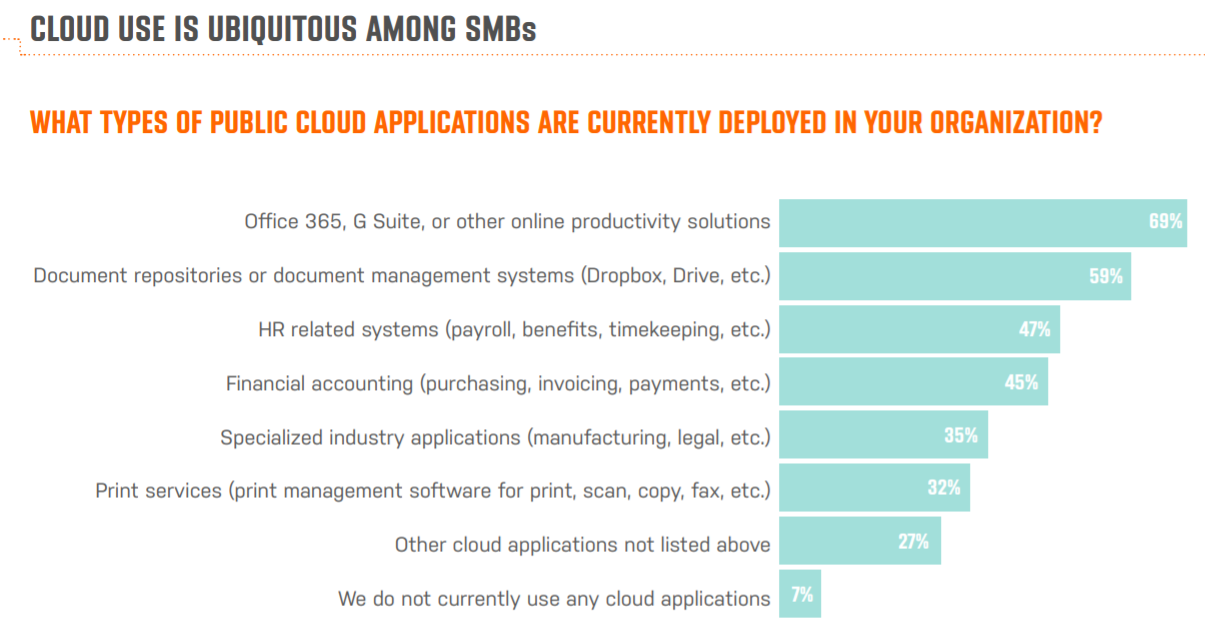
Fully 93 percent of small and mid-sized business respondents to a survey conducted by  Dimensional Research say they use cloud services. A majority of respondents use Office 365 or a similar productivity tool. 

Small business was defined as any organization with fewer than 100 employees Mid-sized business--defined as organizations with 100 to 500 employees. Respondents are from the United States, United Kingdom and Australia. 

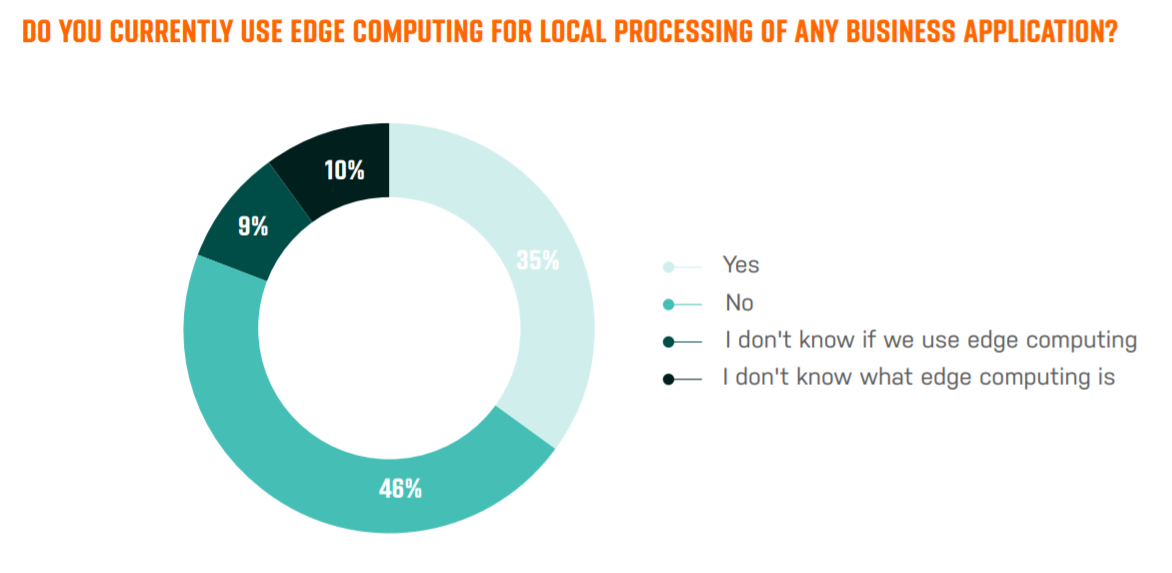
Half take a “cloud-first” approach when selecting applications, the study suggests. In fact, about 46 percent of respondents claim they do no edge processing. About 35 percent say they have at least one application running locally, at the edge. 


Will Edge Compuiting Slow Electrical Consumption of Data Centers?

Investments in hyperscale data center capacity are enormous enough that edge computing capacity will hardly make a dent, early on. These days, access to electrical power, rather than square feet of space, tends to be the measurement. 

But some believe edge computing will slow the rate of power consumption increases, as edge computing might reduce power requirements 14 percent to 25 percent, compared to reliance strictly on hyperscale data centers. 

Where a tier-one hyperscale site might feature 10 megaWatts to 70 megaWatts worth of power access, a cloud data center operated by firms such as Oracle, Baiduand and China Telecom, along with SaaS providers like Salesforce, SAP, Workday, Paypal, Dropbox and platform companies like Uber and Lyft might represent just two to five megaWatts. 

source: Data Center Frontier

In some cases, small edge data centers might feature capability more on the scale of 20 kW to 50 kW. Metro area centers might feature two to five kW.

U.S. data centers consume perhaps 90 billion kW per year, doubling about every four years. So edge computing might well play a role in slowing the rate of electrical consumption increase,

Wednesday, August 28, 2019

By 2020, IoT Connectivity Revenues Might be 10% of Total

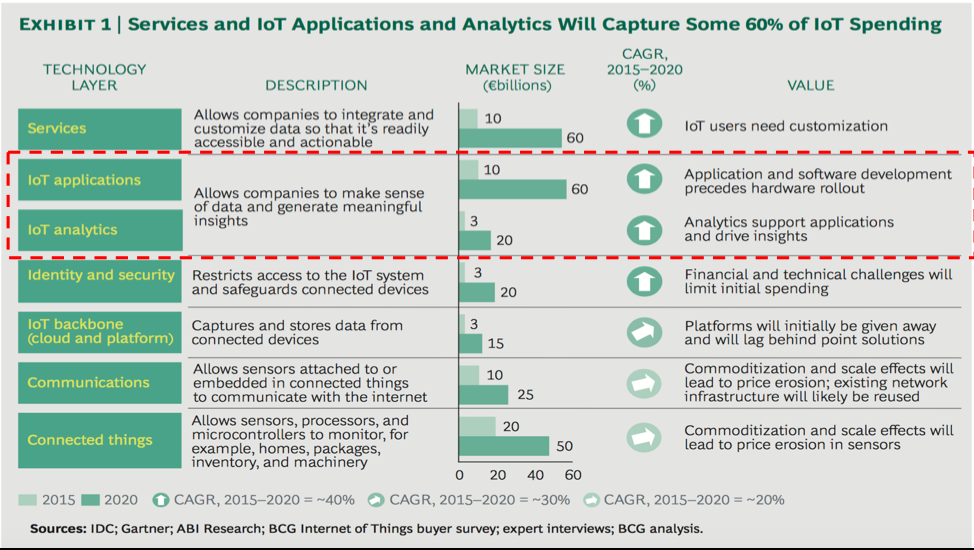
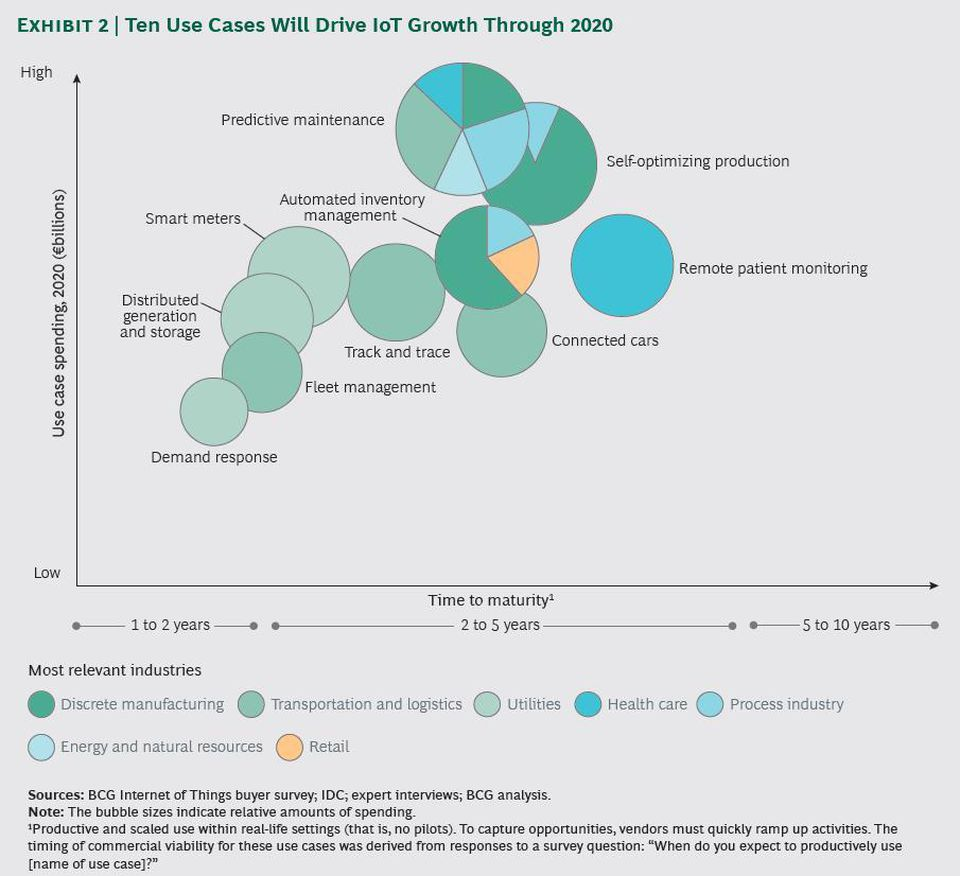
Internet of Things deployments and revenue are growing, and have been since at least 2015, according to BCG. Communications services (network access) might represent about 10 percent of total IoT revenues in 2020. 

That is why it makes sense for connectivity providers to look for additional roles within the ecosystem. 


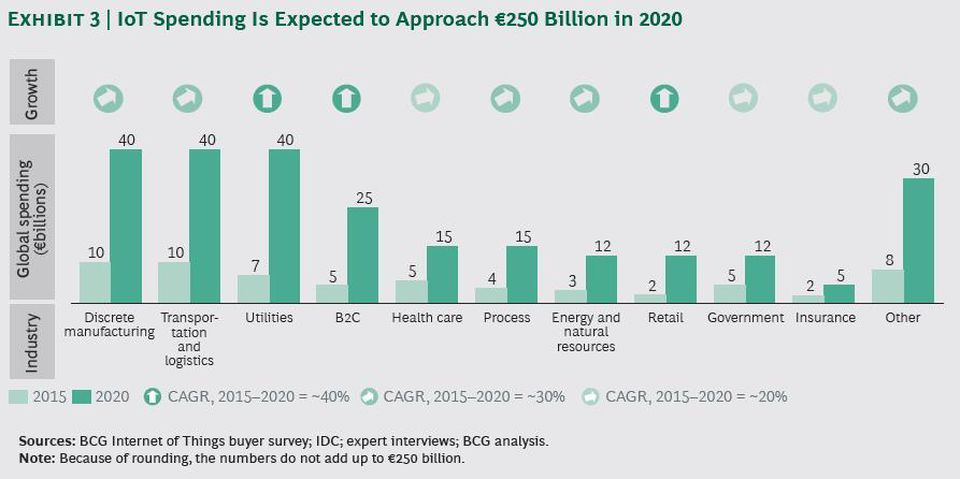
The verticals with the most spending in 2020, according to BCG, are manufacturing, transportation and utilities. 


Smart City Spending Lead by Smart Grids, Traffic, Transit, Surveillance, Lighting

The top priorities for smart cities initiatives are smart grids, followed by data-driven public safety and intelligent transportation, as global spending on smart cities initiatives reaches $189.5 billion in 2023, according to researchers at IDC. 

Together, smart grids, advanced public transit, visual surveillance, outdoor lighting and intelligent traffic management will account for more than half of all smart cities spending throughout the 2019-2023 forecast, IDC predicts.


The use cases that will see the fastest spending growth over the five-year forecast are vehicle-to-everything (V2X) connectivity, digital twin, and officer wearables.

Singapore will remain the top investor in smart cities initiatives, driven by the Virtual Singapore project, IDC says. New York City will have the second largest spending total this year, followed by Tokyo and London. 

Beijing and Shanghai were essentially tied for the number number five position and spending in all these cities is expected to surpass the $1 billion mark in 2020.

On a regional basis, the United States, Western Europe, and China will account for more than 70 percent of all smart cities spending throughout the forecast. Japan and the Middle East and Africa (MEA) will experience the fastest growth in smart cities spending with CAGRs of around 21 percent, IDC says. .

Telco Role in Edge Computing LIkely Highest in Hybrid Scenario

Potential connectivity service provider roles in edge computing vary by chosen role, but also by the value of edge analytics. 

It is fair to note that the advantage of edge computing in some cases hinges on how much analytics contributes to the value of sensor data, in real time or near real time. In essence, the broad choices are processing at the edge, in the cloud (at a remote location) or using a hybrid approach. 

By definition, edge analytics adds value when the analytics are necessary for real-world processes that are very dynamic. On the other hand, remote processing might make more sense when learning does not have very-dynamic implications, and when the amount of raw data transmitted to the remote data centers is reasonable. 

The hybrid approach (some local analytics, some remote analytics) makes sense in scenarios where decisions and response time are optimized, but network data load also is reduced. 

In other words, even if analytics run many times faster at the far edge, there can be latency when the amount of raw data to be crunched is very high (analysis of video feeds, for example), as well as transmission cost implications. 

But analytics location also is controlled by the application setting. Engine performance of a motorcycle perhaps cannot easily be conducted anywhere but at a remote location. But data might be collected and then transmitted in non real time using store and forward

On the other hand, data related to road hazards or mechanical condition of the brakes might have to be displayed and processed locally to have any immediate value. 

Local analytics might also make sense if the edge device has the ability to handle the amount of local processing, and if the device already is fully paid for, thus avoiding recurring transmission costs. 

Longer-term analytics might then be performed by cloud data centers that have gotten the records non real time. 

Telcos and other connectivity service providers arguably have the greatest value in edge computing when hybrid computing is optimal. The edge processing centers might offer small value when the edge devices can process real time data themselves.

Likewise, edge computing for analytics provides small value when data can be processed remotely, in non real time, by cloud data centers. Arguably, the highest value is provided by edge computing facilities when end user devices do not have the ability to process in real time but when near real time analytics are valuable. 

Connectivity service providers can, in principle, choose from various business roles and revenue models of varying risk and value proposition. The lowest risk approaches tend to have lowest value, the highest risk approaches the highest value, as elsewhere in the information technology ecosystem. 

Service providers can choose to create and operate dedicated edge hosting facilities, where the telco owns and manages edge-located compute/storage resources that are connected to the telco network. The customer  runs its software or applications. This is similar to a colocation or hosting revenue model. 

In other cases, the edge computing provider might choose to operate edge infrastructure or platform “as a service.” This is the edge version of the AWS cloud computing model. 

Also, a connectivity provider can choose to operate as a system integrator, providing turnkey information systems that require an edge computing component. 

Connectivity providers might choose to develop their own edge-computing-based solutions for enterprises or other organizations,  

Finally, some connectivity providers might develop end-to-end consumer retail applications based on edge computing support, such as virtual reality for live sports events, for example. 

No matter which approaches are chosen, attempting to have a greater role in edge computing, beyond supplying connectivity, will make sense for larger service providers. Arguably, even the lowest-value edge computing role has more value than the connectivity role alone.