Thursday, March 14, 2019
Goldman Sachs Partner on Edge Computing
Heather Bellini is a partner at Goldman Sachs and heads up the technology research business unit.

Amazon Virtual Private Cloud Tutorial
This tutorial provides an overview of Amazon Virtual Private Cloud (VPC), a commercial cloud computing service that provides users a virtual private cloud, by "provisioning a logically isolated section of Amazon Web Services (AWS) Cloud".
Enterprise customers are able to access the Amazon Elastic Compute Cloud (EC2) over an IPsec based virtual private network. Unlike traditional EC2 instances which are allocated internal and external IP numbers by Amazon, the customer can assign IP numbers of their choosing from one or more subnets.
By giving the user the option of selecting which AWS resources are public facing and which are not, VPC provides much more granular control over security.
SKT, DT, push MobiledgeX for Edge Computing
Where it comes to potential new use cases and revenue streams enabled by 5G, it is hard to miss the role of enterprise internet of things use cases, and therefore the role of edge computing, most often as a way of supporting use cases requiring either low latency or local processing.
In other cases, the use case might be driven by the ability to minimize WAN transport costs.

SK Telecom and Deutsche Telekom have been working together on edge computing since 2016, and SKT now supports the DT MobiledgeX platform.
The partners say mobile edge computing can reduce application latency on mobile networks by up to 60 percent.
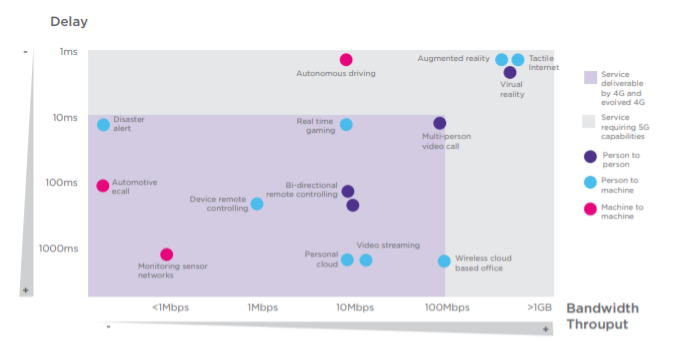
Typically measured in milliseconds, latency is the time taken for a data request to be fulfilled on a packet network. Average latency on today's mobile networks is too high for services that operators want to provide using 5G technology -- including virtual reality, multi-person gaming applications and industrial robotics.
European operators that spoke with Light Reading for an in-depth report on edge computing cite average latency of between 30 and 50 milliseconds over current networks. Cutting that to between 10 and 20 milliseconds would create new service opportunities, according to BT and Vodafone.
Wednesday, March 13, 2019
Edge Computing Density Hinges on Business Model Assumptions
Mobile operator opinions about revenue upside from mobile edge computing mostly mirror executive views about revenue upside from 5G more generally. Which is to say, service providers in East Asia and the United States are much more positive about use cases and revenue generation than are executives in Europe.
To be sure, much of the Euro-skepticism flows directly from the harder business case for mobility services generally. U.S. operators routinely earn higher profits from their services, with greater scale, than happens in Europe.
And while revenue is growing in the United States, it is shrinking in Europe. So European mobile execs can be forgiven for feeling less bullish about the upside from infrastructure edge computing.
Some have suggested, for example, that Vodafond might need several hundred edge data centers in the U.K. market, based on use cases calling for latency less than 15 milliseconds to 20 milliseconds.
"I think that is vendor wishful thinking," said Scott Petty, Vodafone UK CTO. "The use cases don't exist for why we would want to do that."
In the near future, he said, eight data centers would be enough for latency of between 15 and 20 milliseconds.
Even when lower latency performance is necessary, the number of required edge data centers is unlikely to exceed 64 across the United Kingdom.
On the other hand, Telefonica, for example, already has 7,000 main central offices in Spain, where DT has just 900 across Germany. In other words, some mobile operators already have a bigger footprint of potential edge aggregation sites.
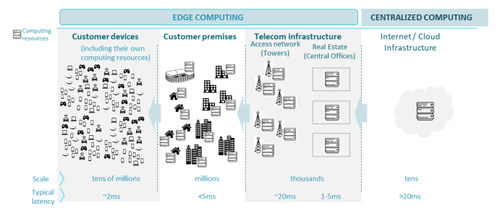
But Juan Carlos Garcia, Telefónica director of technology and architecture believes even edge computing in Spain might require only a few hundred locations. That grows from a belief that not so many apps actually will require latency so low the edge computing location must be located a few kilometers from the end user devices.
It all hinges on one’s estimate of the business model and the use cases. On that score, there still is no consensus about levels of latency performance that might be required, or when.
5G and Edge are Hard to Separate
“5G is about taking all of the cloud experiences that we’ve created in the data center and making sure they are mobile friendly and we have a mobile infrastructure that’s designed as a cloud platform," says Dell EMC CTO John Roese. "Really what we’re doing with 5G is extending the cloud to the mobile edge.”
Tuesday, March 12, 2019
New HPE Edge Computing Platform
HPE’s new edge platform, the HPE Edgeline EL8000 Converged Edge System was developed to enable connectivity provider edge computing. How important that might be hinges on roles beyond connectivity, within the information technology or application ecosystems, are key parts of service provider strategy. Not every supplier must do so.
Still, argues HPE, “The telecommunications industry has been going through a fundamental shift for several years.”
Service providers “are changing their business model from solely providing connectivity, to providing digital services to their customers,” HPE says Tom Bradicich, HPE VP and GM for servers, edge and IoT systems.
And Bradicich believes computing at the edge is essential, for reasons ranging from latency performance to data protection.
Latency performance always tops the list of reasons why edge computing is needed. “What good is an Internet-connected car if there's a lag between when a child appears in front of the car and when the system actually tells the car to stop?” says Bradicich.
But bandwidth volumes, which bring wide area network transport costs, are another valid reason for edge computing. One study found significant cost savings from avoided capacity charges.
Compliance can be an issue in countries that ban export of data for processing.
Storage costs are another area of possible savings, especially when the bulk of data has little to no value. Processing at the edge can mean eliminating the need for remote storage and transmission.
Monday, March 11, 2019
Multi-Cloud, Edge Computing, Virtualization
Tom Burns, Senior Vice President and General Manager, Dell EMC Networking and Solutions and Shekar Ayyar, VMware Executive Vice President, Strategy and Corporate Development, and GM, Telco Group discuss edge computing, multi-cloud, virtualization. These days, multiple trends shape networking and computing.
Best Use Cases for Edge Computing: Both High Bandwidth, Low Latency
The “best” use cases for new apps enabled by 5G and edge computing are those requiring both ultra-low latency and very-high bandwidth, including autonomous vehicles, augmented reality, virtual reality and “tactile internet” (immersive gaming) apps.
Even if the focus often is on 5G network performance, that often is only part of the story. Many new use cases will require not only near-zero access network latency, but also computing with near-zero latency. And that will happen at the edge, whether on the device itself, on the premises or at some metro location (based of a cell tower, a mobile aggregation site or switching center).
Hyperscale Data Center Operators Boost Capex 43% in 2018
As a rule, firms invest capital when they believe they will grow their revenues, when they believe they must make defensive investments to protect themselves from key competitors or when they believe they can take market share. So some will draw conclusions based on the increases and decreases in capital investment by leading telcos and leading data center providers.
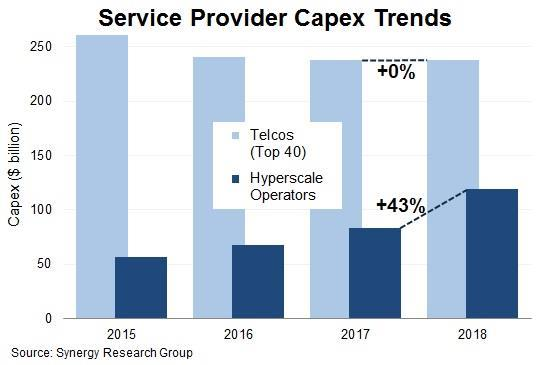
Analysts at Synergy Research Group say telco capex is flat, while data center capex is growing substantially.
Full-year hyperscale capex jumped 43 percent in 2018, while telco capex saw no growth.
The top five hyperscale spenders in 2018 were Google, Amazon, Microsoft, Facebook and Apple. Their aggregate 2018 capex was almost identical to the capex of the top five telco spenders: China Mobile, AT&T, Verizon, NTT and Deutsche Telekom.
Sunday, March 10, 2019
Edge Computing a Solution for WAN Costs, as Much as Latency
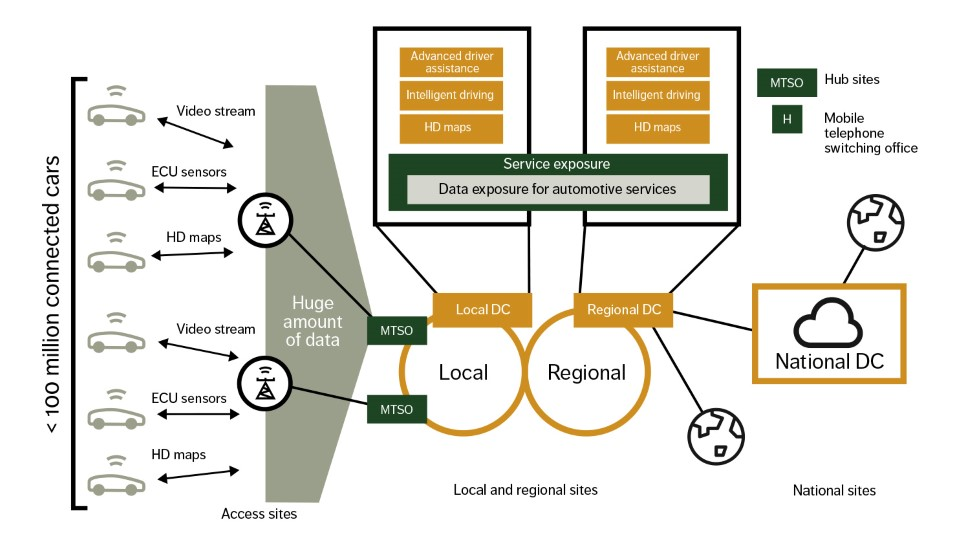
The future data center business is likely to be more decentralized and layered than today’s hyperscale model suggests. Looking only at data created by connected vehicles, which might number 700 million by 2025, data volume transmitted between vehicles and the cloud will be around 100 petabytes per month, many predict.
Ericsson believes data volumes will be higher than that, reaching as much as 10 exabytes or more per month by 2025, which is approximately 10,000 times larger than the present volume of cloud data.
Some estimate data created by each connected vehicle might be one terabyte per month.
So latency, per se, might not be the problem that edge computing has to solve. Instead, minimizing data transport costs across wide area networks might actually be as important for many use cases.
Wednesday, March 6, 2019
Maybe Ultra-Low Latency Will Not be the Use Case for Many Edge Computing Apps
Eventually, we might find that avoiding local access bottlenecks and high bandwidth bills is as big a driver of edge computing as the need for ultra-low latency processing speed. “If you need to analyze a large amount of data, your internet connection might not be able to cope with the data flow, and it would result in your inability to extract real value from data,” says Riccardo Di Blasio.
In other cases, WAN bandwidth charges might be the issue. “If you are an oil and gas company which is drilling in Angola and requires computing, today the alternatives are to either build your own data centers like in the 90s, (with all the cost, and scale limitations associated with) or to use a cloud provider (where the nearest datacenter will be probably in the UAE or South Africa, at least 5,000 miles away) with enormous costs and pretty lousy SLAs,” says Di Blasio.
New Use Cases are Driving Demand for Edge Computing
By 2025, almost 20 percent of data created will be real-time in nature, rather than being sent to the core of the network for processing, says B.S. Teh, Seagate SVP. That is the sort of use case that benefits from local processing at the edge, or close to where the data actually is generated.
“We see edge as a big driver of growth,” he said. Some growing use cases, such as video surveillance will benefit from edge processing, sometimes not because latency is always so important, but simply to avoid wide area network transport costs.
The top reason for using edge computing is ultra-low latency. But there are other drivers, including use cases where processing at the edge alleviates the need to move bulk data generated by bandwidth intensive apps across the wide area network.
Wikibon compared the three-year management and processing costs of a cloud-only solution using AWS IoT services compared with an edge-plus-cloud solution, to support cameras, security sensors, sensors on the wind-turbines and access sensors for all employee physical access points at a remote wind farm.
At a distance of 200 miles between the wind-farm and the cloud, and with an assumed 95 percent reduction in traffic from using the edge computing capabilities, the total cost is reduced from about $81,000 to $29,000 over three years. The cost of edge-plus-cloud computing is about a third the cost of a cloud-only approach, Wikibon estimated.

Subscribe to:
Posts (Atom)