Monday, December 21, 2020

Verizon Teams with Deloitte for Smart Factories Using Edge Computing

Verizon Business is teaming with Deloitte to create 5G and mobile edge computing solutions for manufacturing and retail, ultimately expanding to other sectors. The collaboration presumably will build on Deloitte’s Smart Factory Fabric, a cloud-enabled smart manufacturing solution developed with Amazon Web Services (AWS).


Deloitte will act as a system integrator while Verizon’s supplies the mobile and private enterprise wireless networks, 5G Edge MEC platform, internet of things, Software Defined-Wide Area Network (SD-WAN), and VNS Application Edge capabilities.


The companies are co-developing a smart factory solution at Verizon’s Customer Technology Center in Richardson, TX that will use computer vision and sensor-based detection coupled with MEC to identify and predict quality defects on the assembly line and automatically alert plant engineering and management in near real-time.


Verizon says the companies will also introduce an edge compute environment for next generation applications.


 “By bringing together Verizon’s 5G and MEC prowess with Deloitte’s deep industry expertise and track record in system integration with large enterprises on smart factories, we plan to deliver cutting-edge solutions that will close the gap between digital business operations and legacy manufacturing environments and unlock the value of the end-to-end digital enterprise,” said Tami Erwin, CEO of Verizon Business. 


Friday, December 18, 2020

IoT: Same Story, Different Location

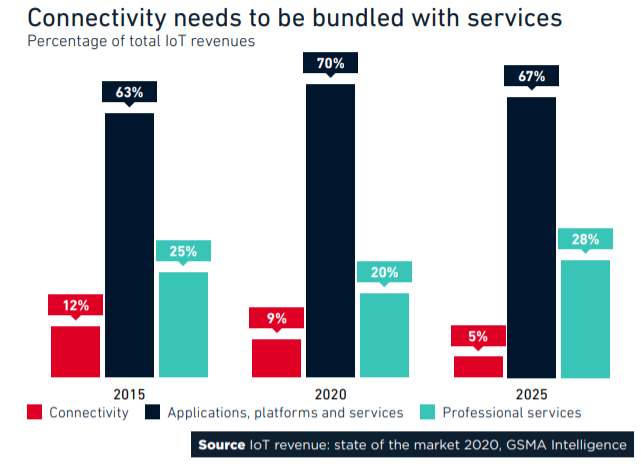
Revenue from internet of things connectivity will be important for connectivity providers, but, as always, is a percentage of ecosystem revenue. In that sense, connectivity providers face the same issue in the IoT business as they do in the edge computing, video entertainment, voice, messaging and enterprise services businesses: most of the money lies in apps, platforms and professional services, not connectivity. 


source: GSMA Intelligence


Wednesday, December 16, 2020

How Much Commercial MEC Revenue Can be Generated, Early On?

Network operator spend on multi-access edge computing will grow from $2.7 billion in 2020 to $8.3 billion in 2025, says Juniper Research.  By 2025, the number of deployed MEC nodes will reach two million globally in 2025, up from 230,000 in 2020. These devices, which take the form of access points, base stations, and routers, Juniper Research says.


What perhaps is not so clear is the expected value those MEC investments will produce. Since the 5G core network is itself virtualized, edge computing locations and devices will be necessary for distributed radio access network functions, at the very least. 


Beyond that, mobile operators hope their MEC investments will translate into retail revenues from commercial customers, including hyperscale app providers and cloud computing firms using connectivity network assets to support their own retail edge computing services. 


At the moment, mobile operator commercial revenues are probably in low single-digit millions, and much of that generated in the form of hosting services at the edge for hyperscale “computing as a service” providers. 


At least for a while, MEC might produce higher value for operators as a support for their core networks than as a commercial revenue source.


U.S. Crop Yields Benefit from Broadband, Probably IoT, Study Finds

Precision agriculture using internet of things sensors and analytics, as well as e-commerce enabled by broadband internet access might be responsible for higher U.S. farmer crop yields, researcher Katherine LoPiccalo finds. “Corn, cotton, hay, soybeans and wheat yields are all positively and significantly correlated with increased 25+/3+ broadband penetration rates,” LoPiccalo says. 


“A one-percent increase in the number of 10+/0.768+ connections per 1,000 households is associated with an approximately 6.5 percent decline in fertilizer expenses per operation and a 3.4 percent decrease in seed and plants expenses per operation,” she notes. 


An analysis of farm yields and broadband finds that a one-percent increase in the number of 25 Mbps/3 Mbps or better broadband connections per 1,000 households is associated with a 3.6 percent increase in corn yields, as measured in bushels per acre, the Federal Communications Commission’s Office of Economics and Analytics finds. 


It is not possible to conclusively prove whether e-commerce or IoT are responsible for the improvements. It seems logical enough that e-commerce leads to  loweri input or other supply costs, in part because farmers are able to comparison shop and therefore buy inputs at lower prices. 


As always, correlation is not necessarily causation, but LoPiccalo suggests some logical ways correlation might be causation, and “may influence farm outcomes.” In addition to e-commerce that might “impact farm profitability by directly lowering input or other supply costs,” 


An improved bargaining position might include the ability to negotiate with their traditional suppliers for better prices, as farmers are no longer locked into offered rates from the local farm store or co-operative,” she says. 


“A more salient mechanism derives from the use of Internet connectivity to extract real time, accurate data on crop yields, soil moisture levels, plant health, and equipment conditions,” a direct result of the use of internet of things sensors and analytics. 


Tuesday, December 15, 2020

Who Owns the Edge Computing Customer?

One obvious issue for hyperscale “cloud computing as a service” providers working with mobile operators to supply edge computing is the always-important issue of value and revenue shares. 


"I think the challenge around that might be who takes what piece of the value chain 

 and who owns the customer?” notes BT Chief Architect Neil McRae.  


At least so far, it appears that the hyperscalers will actually own the customer


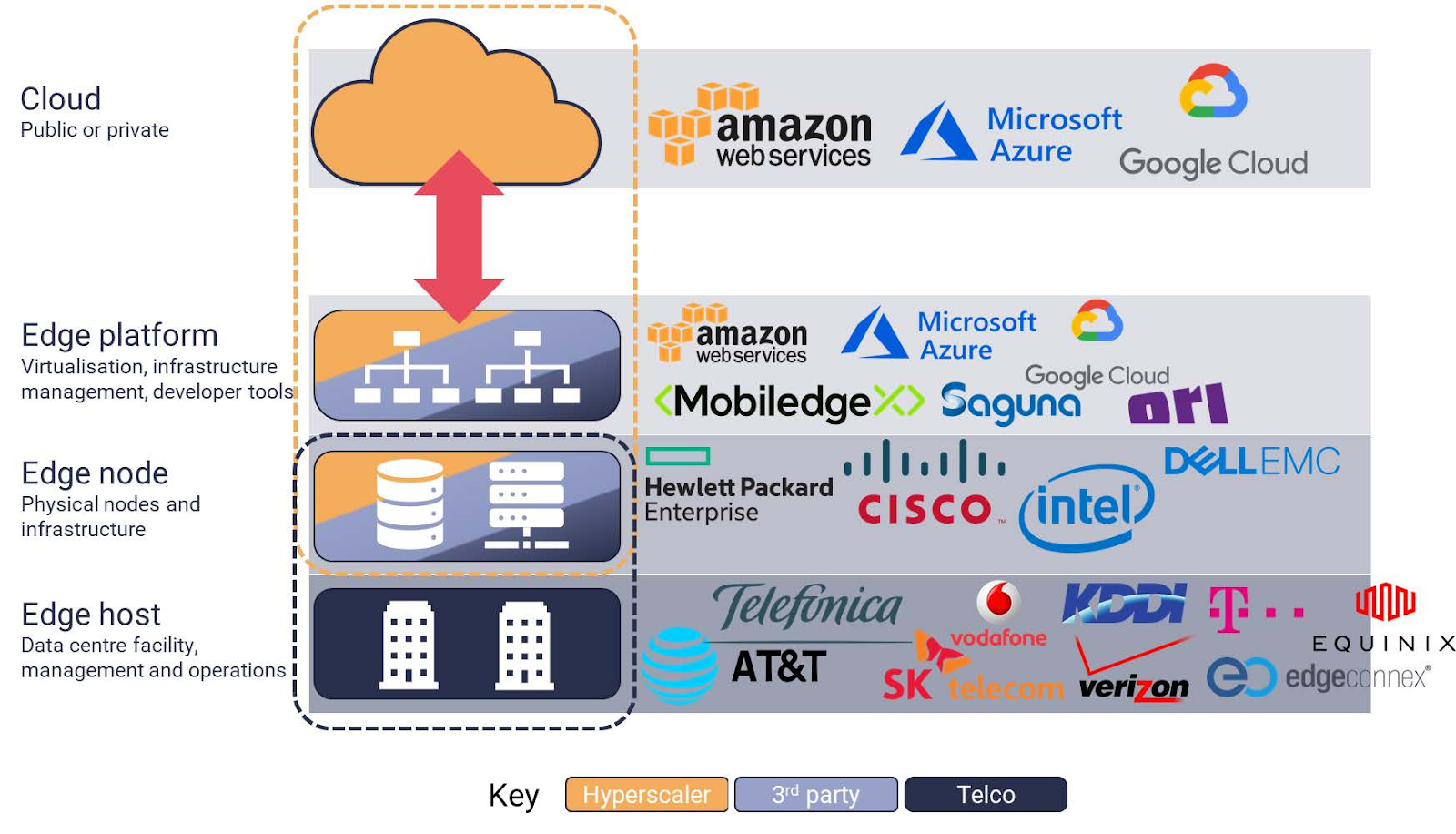
Generally speaking, with the exception of Mobiledge, which hopes to create an edge platform controlled by service providers, the edge platform space is occupied by the same names you would expect to see leading cloud computing as a service. 


Real estate--facilities, racks, electricity, security, rackspace and access network colocation--was among the reasons for the interest in multi-access edge computing on the part of connectivity providers. 


Recent deals made by hyperscalers with mobile operators--including Google Cloud with AT&T or Verizon with Amazon Web Services confirm that trend, with telcos acting as providers of edge real estate. 


Device suppliers, also as one might expect, are supplying the edge hardware. 


How much of a platform role telcos might create, as opposed to providing real estate and dumb pipe colocation remains to be seen. Some observers estimate telco edge revenues at between $2 billion and $4 billion by 2025, for example.


source: STL Partners 


Though connectivity revenue will be significant for telcos, it might not be so large as some think. The analogy is the internet of things, also a big potential revenue opportunity for telcos and others in the ecosystem.  As now projected, connectivity provider direct revenues in the IoT ecosystem are a relatively small portion of the total revenue opportunity.  


Perhaps it is not too early to argue that, in IoT as well as edge computing, it is likely to be hyperscalers, enterprises or system integrators who wind up “owning the customer.”


Monday, December 14, 2020

Data Center Infrastructure Spending in 3Q 2020: Public Cloup Up 21%, Enterprise Down 8%

Worldwide spending on data center hardware and software nudged upwards by two percent from the third quarter of 2019, thanks entirely to a 21 percent jump in spending on public cloud infrastructure, which pushed it to an all-time high, says Synergy Research Group. 


Meanwhile enterprise spending on their own data center infrastructure dropped eight percent from last year, the third consecutive quarter to feature a substantial decline, the firm says. 

source: Synergy Research Group 


Enterprise spending on cloud services got a big boost in the third quarter, as COVID-19 drove changes in enterprise behavior and sped up the transition from on-premise operations to cloud-based services, Synergy Research says. 


source: Synergy Research Group

Telco MEC Role Shaping Up

In the early days of the edge computing ecosystem, and despite the hopes many participants have for revenue growth based on edge computing, roles in the ecosystem are starting to shape up. Since edge computing as a service remains a “computing service,” it is perhaps entirely logical that the hyperscalers who dominate cloud computing would be leading suppliers of edge computing that is an extension of their cloud offers. 


source: STL Partners 


Generally speaking, with the exception of Mobiledge, which hopes to create an edge platform controlled by service providers, the edge platform space is occupied by the same names you would expect to see leading cloud computing as a service. 


Real estate--facilities, racks, electricity, security, rackspace and access network colocation--was among the reasons for the interest in multi-access edge computing on the part of connectivity providers. 


 Recent deals made by hyperscalers with mobile operators--including Google Cloud with AT&T or Verizon with Amazon Web Services confirm that trend, with telcos acting as providers of edge real estate. 


Device suppliers, also as one might expect, are supplying the edge hardware. 


How much of a platform role telcos might create, as opposed to providing real estate and dumb pipe colocation remains to be seen. Some observers estimate telco edge revenues at between $2 billion and $4 billion by 2025, for example. 


The concern some might express is that the incremental new revenue and profit margin from real estate (hosting) at the edge--and any significant “platform” opportunity--might not be large enough to offset expected revenue losses from legacy services and average revenue per user diminution. 


Of course, one way of looking at edge computing is to view it as a necessary capability mobile operators will require in the 5G and coming eras simply to operate their virtualized networks. In other words, edge computing might be more important as a “cost of infrastructure” and “capabilities” spending item than a revenue source.


There will be some incremental revenue for telcos from edge computing, but importance might be derived from support of core network operations and the indirect effect of edge computing in getting and keeping business customers on the network. 


Friday, December 11, 2020

Cloud Computing Market Remains Unstable

"A stable competitive market never has more than three significant competitors, the largest of which has no more than four times the market share of the smallest,” Bruce Henderson, founder of the Boston Consulting Group has argued.


Sometimes known as “the rule of three,”  he argued that stable and competitive industries will have no more than three significant competitors, with market share ratios around 4:2:1.


If you look at market share in the “cloud computing as a service” industry, one does not yet see that pattern, suggesting major market share shifts are likely. But most of the activity, all other things being equal, will happen at positions two to four. 


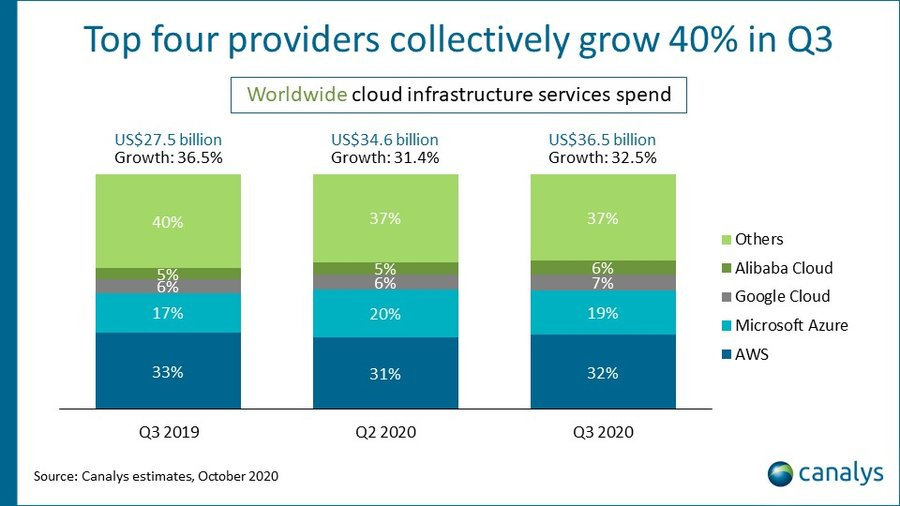
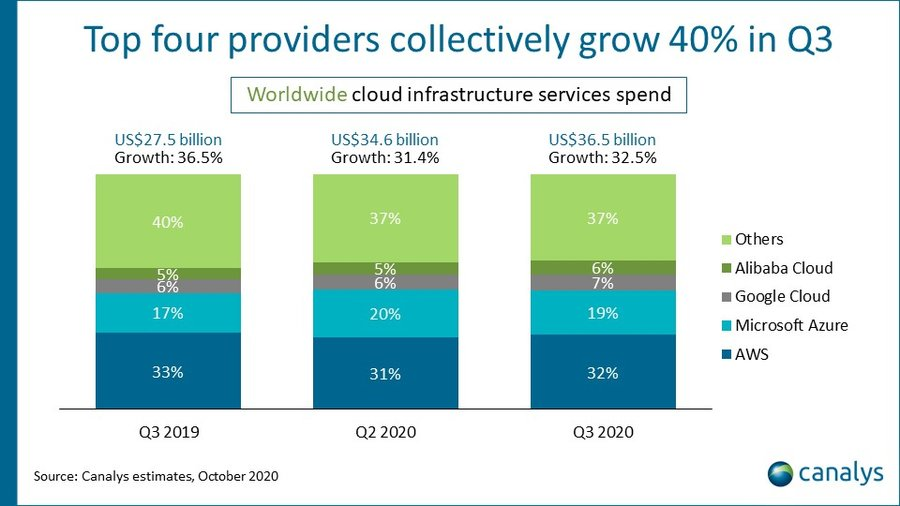
AWS now has 32 percent share. By some estimates Microsoft has 19 percent share. Google Cloud about seven percent share. The rule of three would predict either that AWS eventually would have more share, or that number two would have less share, or both. 


I believe the reported numbers overstate Microsoft’s share and understate Google’s share, however. 

source: Canalys 


If a “like to like” analysis of “computing as a service” revenues are made, Microsoft’s actual cloud revenues are far smaller than reported. 


The problem is that the way Microsoft reports revenue dramatically skews the results. 


Azure, which includes cloud computing revenue, also includes sales of the Windows operating system, productivity suites, Xbox, Surface and advertising. 


Also, keep in  mind that Azure cloud computing also includes server sales, not just “cloud computing as a service” revenues. 


The “intelligent cloud” segment of Azure represents only about 35 percent of total Azure revenue. Another third of Azure revenue comes from productivity suite revenues. Also, 32 percent of Azure revenue comes from operating systems, productivity suites, Xbox, Surface and advertising. 


I personally do not consider those revenue sources a “like to like” comparison with AWS cloud computing as a service revenues. Actual Azure cloud computing revenue. might be as low as $4 billion a quarter. The point is that any analysis of cloud computing market share based on Azure revenue is incorrect. 


Azure cloud computing might be only a bit larger than Google Cloud, which generated about $3.4 billion quarterly revenues recently. 


If so, AWS market share is understated and Microsoft’s share is vastly overstated. At $4 billion quarterly revenue, Microsoft likely has about 11 percent share. Google might have about nine percent share. 


If AWS generated about $11.6 billion in revenue in the third quarter of 2020, then AWS did have about 32 percent of global cloud computing market share. 


A corollary is that, all things being equal, it will be very hard to supplant Amazon Web Services as the market leader. It is unclear at this point which firm emerges as a stronger number-two provider. Many seem to be betting on Microsoft, based on its apparent or reported growth rate. 


In the absence of better data, it is hard to say.


Wednesday, December 9, 2020

Cloud Market Grows 33% in 3Q 2020

The global cloud market grew 33 percent  to US$36.5 billion in the third quarter of 2020, up US$2.0 billion quarter over quarter and up US$9.0 billion year over year, according to Canalys. 


source: Canalys 


Tuesday, December 8, 2020

Edge Computing Driven by Cloud Hyperscalers, Telcos Will Reach $12 Billion in 2021, Deloitte Predicts

Deloitte predicts that edge computing will grow about 35 percent in 2021, driven by cloud hyperscalers and connectivity providers, generating about $12 billion. Deloitte does not specifically break out revenues by provider, so the portion earned by cloud providers and telcos providers of edge computing activity is not so clear. 

Some larger telcos will try to sell retail edge computing as a service. Others will earn revenues by partnering with edge computing providers in some way, providing real estate services, for example, integrating 5G access in some way or co-selling edge computing provided by telco partners.


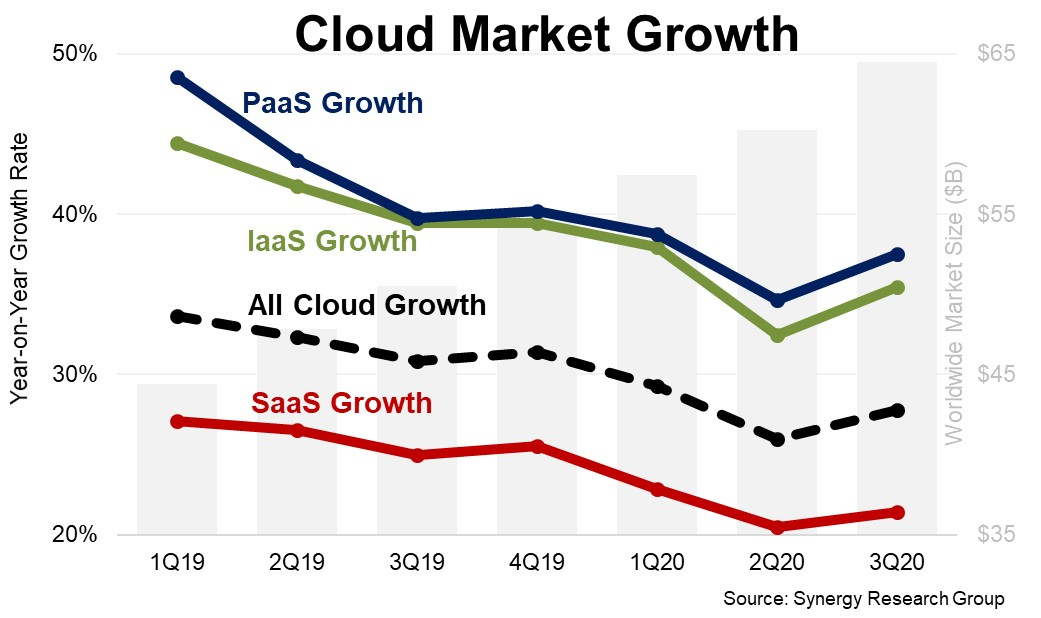
Separately, cloud growth, says Deloitte, was slowing before the Covid-19 pandemic. 

source: Deloitte


Google Cloud Adds 200 ISV Partners to Edge Cloud

Google Cloud will support more than 200 independent software vendors on its edge  platform, starting with a launch of 30 apps supporting internet of things, media delivery, retail operations and other horizontal functions (commerce, analytics, network slicing, artificial intelligence, security and subscriber identification module management, for example). 


Those apps build on the Global Mobile Edge Cloud, enabling 5G solutions built jointly with telecommunications companies such as AT&T. 


Anthos for Telecom also is supported at the network edge, allowing telecommunications companies to run their applications wherever it makes the most sense within the network, an obvious use case and requirement for virtualized networks such as 5G.