Tuesday, March 17, 2020

Nokia Addes Edge Computing Support to Global WING IoT Managed Service
Nokia has announced that it is adding 5G and edge computing support capabilities to its Worldwide IoT Network Grid (WING) managed service.
AT&T will be using Nokia’s Worldwide IoT Network Grid (WING) for enterprise IoT customers. The deal includes the core network, dedicated IoT operations, billing, security, and data analytics.
Wing is expected to be available in more than 20 countries by the first quarter of 2020. That means the company’s enterprise IoT customers will be able to manage connectivity across all those networks.
Worldwide IoT Network Grid (WING) is a cloud-native, globally-distributed, IoT core network managed service compatible with 3G, 4G, NB-IoT access networks, allowing operators to accelerate time-to-market, at lower costs and risk,
<iframe width="560" height="315" src="https://www.youtube.com/embed/Sv-HnerxhXc" frameborder="0" allow="accelerometer; autoplay; encrypted-media; gyroscope; picture-in-picture" allowfullscreen></iframe>
The managed service includes four initial offerings, two horizontal and two vertical, for agriculture, livestock management, logistics and asset management.
- Smart Agriculture as-a-Service: Sensors capture environmental, soil and crop data that is then analyzed to provide insights that help farmers manage crops more effectively, potentially saving costs on irrigation, pesticides and fertilizers.
- Livestock Management as-a-Service: Tracking devices and biosensors monitor animal health and welfare to provide ranchers with early alerts if abnormalities are detected, protecting valuable livestock and improving yields.
- Logistics as-a-Service: IoT sensors enable tracking of the global movement and condition of goods through the complete supply chain to help enterprises instantly identify incidents and even predict future events to optimize delivery and logistics process efficiency.
- Asset Management as-a-Service: Connecting products anywhere in the world enables their status and performance to be monitored centrally, helping enterprises provide a better service to their business and consumer customers.
Sunday, March 15, 2020
IoT, Edge Computing Partnerships Still Mostly Dumb Pipe?
At least so far, the value of an IoT partnership or edge computing partnership between connectivity providers and hyperscale cloud computing firms follows the typical pattern: access supplied by the telco; services and apps by the partner.
To be sure, that is not the only conceivable role a service provider can play. In some cases, telcos might actually seek to create applications and services as well.
Still, so far, IoT and edge computing partnerships tend to be new examples of dumb pipe roles for connectivity providers, with a possible incremental boost to real estate revenue, when telco facilities are used as edge data centers.
Google’s Global Mobile Edge Cloud program aims to create a portfolio and marketplace of 5G solutions built jointly with telecommunications companies; an open cloud platform for developing these network-centric applications; and a global distributed edge for optimally deploying these solutions, Google Cloud says.
Verizon's partnership with AWS for the new Wavelengths service is a similar sort of deal, where Verizon supplies the edge real estate and AWS supplies the computing service.
A collaboration with AT&T is part of the Mobile Edge Cloud effort, where AT&T supplies the network while Google Cloud supplies the computing functions.
That might strike you as yet another instance of telcos supplying connectivity (dumb pipe) while somebody else supplies the applications. Realists might say that is about as good as it gets, in many cases.
Friday, March 13, 2020
Cloudflare Building Edge Data Centers
Cloudflare, which helps companies make their web services run faster and be more secure – and which more recently started to use its global data center network to also provide cloud computing services – said it would expand the network in the US with three dozen new locations. Shortly thereafter, the company said it would add even more locations in the US – about the same amount as in the first announcement.
It will use Vapor IO and EdgeMicro for edge computing locations. All the locations, Vapor and EdgeMicro, will run Cloudflare’s full set of services.
Today, Cloudflare says it is within 100 milliseconds of 95 percent of the world's population, or 99 percent if you look at internet users in the developed world,” said Nitin Rao, head of global infrastructure at Cloudflare.
EdgeMicro suggests the new edge deployments show initial roundtrip statistics of between 50 and 75 milliseconds. The company believes it can get down to sub-20, maybe even sub-10 milliseconds.
Each remotely-managed Vapor site has between 150kW and 180kW of power capacity across high-density 35kW racks. EdgeMicro says most of its clients want 8kW to 10kW per rack, and the Cloudflare deployment is smaller than that.
Telefónica and Idrica Partner for Water Service IoT Services
Telefónica and Idrica, a company specializing in “digital transformation of water cycle management,” have signed a global partnership agreement to provide services to companies in the water sector, focused on operations management and maintenance.
The agreement includes the development of solutions supported by NB-IoT, LTE-M and 5G networks. The solution allows companies to monitor real-time information on all their infrastructures and processes in one single place and automate recurring tasks, Telefónica says.
As with most such partnerships, Telefónica is likely to supply the connections, Idrica the software and hardware for internet of things operations. Telefónica says it supplies more than 30 million IoT connections worldwide.
What remains to be seen, as always, is the value Telefónica can bring, and how that translates into revenue for Telefónica. Connection revenue alone is not expected to be a huge revenue generator. Where early on it seemed IoT connections would generate US $1 to $2 per month per device, prices already have dropped to a bit over $1 in many cases, and some IoT connections might already be half of that.

source: Jasper
source: Jasper
It also supplies Kite, an in-house solution to manage IoT devices with a dedicated network infrastructure globally deployed and hosted in the cloud.
Since November 2019, IoT, big data, cloud and security services sold by Telefónica are part of Telefónica Tech, the new unit with which Telefónica wants to boost the growth of these new digital businesses.
Thursday, March 12, 2020
Wednesday, March 11, 2020
42 Billion IoT Devices in Use by 2025?
The number of devices connected to the Internet, including the machines, sensors, and cameras that make up the Internet of Things (IoT) will reach 41.6 billion by about 2025, IDC predicts.
Those connected IoT devices will generate 79.4 zettabytes (ZB) of data in 2025.
Some might call that forecast optimistic or aggressive, but Cisco believes IoT devices could represent as much as half of all connected devices, while driving about six percent of traffic, by about 2022.
IDC projects that the amount of data created by connected IoT devices will see a compound annual growth rate (CAGR) of 28.7 percent to 2025. Notably, most of the data will be generated by video surveillance appliances in the near term, growing to include industrial and medical devices over time.
While the video surveillance category will drive a large share of the IoT data created, the industrial and automotive category will see the fastest data growth rates over the forecast period with a compound annual growth rate of 60 percent, IDC estimates.
Tuesday, March 10, 2020
Will Edge Computing Enable Lower-Cost Devices?
It is too early to say for sure, but someday, as edge computing becomes about as ubiquitous as Wi-Fi now is, it might be possible to design lower-cost smartphones that derive much of their functionality from edge computing facilities rather than from internal firmware. That is one way the spiraling cost of leading-edge phones could be blunted.
Also, edge support for smartphones, if it allowed the use of phone equivalents of thin client computers, might prove one of the most-important use of edge computing capabilities for mobile service providers, much as 5G and virtualization of network cores is important for service providers as a way of radically lower cost per bit.
If past is prologue, it might take decades for the edge computing fabric to become ubiquitous enough to allow that to happen.
The idea is not especially new, having been dubbed by Sun Microsystems network computing back about 1984. The idea was that what we now call distributed computing or cloud computing would allow devices to be “thin” clients drawing much of their compute from a server.
In a client-server environment that meant a lower-cost “sort of dumb” terminal instead of a personal computer., mimicing the dumb terminals of the mainframe era. It might seem crazy now, but in the 1970s there were whole word processing built on the use of mainframes and dumb terminals, built to support that single function.
In 1983, when I was a reporter at a Gannett newspaper, I believe we used the Atex system for composing stories, featuring dumb terminals wired to a mainframe.
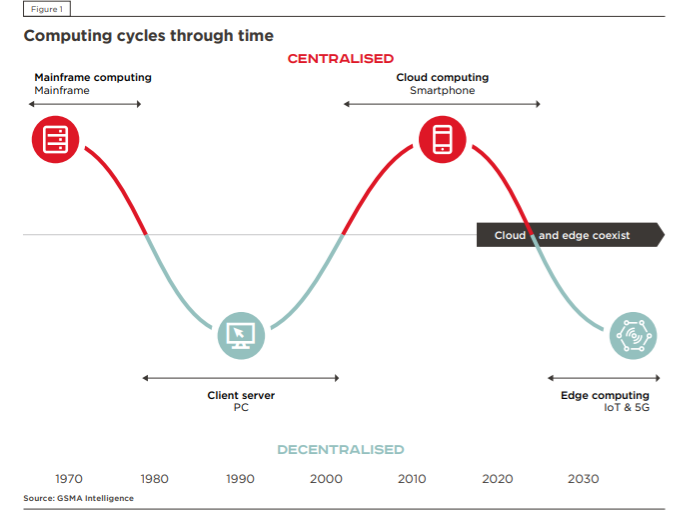
Ironically, though the concept never really caught on in terms of devices--which remained smart, with local computing resources-- the idea of using centralized computing resources was common in the client-server era as well as in the cloud computing era.
It may remain equally powerful in the coming era of edge computing, ambient computing or whatever other term eventually emerges. But the difference might be--once again--the issue of how much capability the client device must possess to supply functionality.
There is at least some hope that, with widespread edge computing with very-low latency, some functions resident on the device can be omitted, with reliance being on the edge computing fabric for those functions.
De
At least in principle, that would mean the ability to create functional devices available at lower cost. In the last two computing eras--whether centralized or distributed--use of remote servers has become a foundational assumption.
It has been true for possibly a decade that smartphones have gotten so advanced it has become hard to create some big new feature to drive widespread device replacement beyond normal wear and tear cycles. Some believe foldables or 5G could prove the foundation for an upsurge of innovation and features.
At least initially, device cost will be a limiting issue, as foldables might cost as much as $2000 each, while 5G devices could easily cost $1200 each. Over time, costs will drop, of course. But lower cost is key to widespread deployment.
Tier-One Mobile Operators Plan Interoperable Edge Computing Platform
China Unicom, Deutsche Telekom, EE, KDDI, Orange, Singtel, SK Telecom, Telefonica and TIM have joined forces, with the support of the GSMA, to develop an interoperable platform to make edge compute capabilities widely and easily available.
The platform to be developed in 2020, will make local operator assets and capabilities, such as latency, compute and storage available to application developers and software vendors enabling them to fulfil the needs of enterprise clients, GSMA says.
As always, several different business models are feasible, ranging from relatively simple common interfaces and management systems across carrier domains. Colocation is possible.
In other cases actual computing as a service, available from multiple carriers across the globe, might be available.
The platform will be deployed across multiple markets in Europe and progressively extended to other operators and geographies to achieve global reach, GSMA says.
Interoperability across multiple service provider domains is an important feature for many services aimed at enterprises. What is a bit unclear at the moment is whether the effort yields higher order or lower order interoperability.
At lower orders of interop enterprise customers might have assurances that their services work across domain boundaries. At higher levels perhaps the computing functions are standardized across domains.
Other entities are developing edge compute capabilities as well, including hyperscale computing giants, tower companies and others. Much may hinge on what features customers seek, and whether a relative handful of hyperscale platforms choose to colocate.
Some enterprises will want to rent compute cycles or storage, but run their own apps. Hosted services might work.
Others will want a local version of whichever hyperscale compute environment they already use. In such cases, the edge computing must include the relevant hyperscale platform. The same holds for enterprises that are using more than one compute platform at the edge, or a mix of hyperscale platforms across the enterprise.
Thursday, March 5, 2020
Google Launches Mobile Edge Cloud with AT&T
Depending on how you wish to view it, Google’s new Global Mobile Edge Cloud strategy, which will deliver a portfolio and marketplace of 5G solutions built jointly with telecommunications companies, is about as good a role as connectivity providers likely can hope for, or stark recognition that a real estate play was always going to be the role service providers would assume.
Google Cloud and AT&T announced they will work together to “help enterprises take advantage of Google Cloud’s technologies and capabilities using AT&T network connectivity at the edge.”
One might translate that as “computing at the edge will be supplied by Google, racks, energy, cooling and security at the edge by AT&T,” albeit with access using the low-latency 5G network.
The two companies are testing a portfolio of 5G edge computing solutions for industries, such as retail, manufacturing, and transportation, that bring together AT&T’s network, Google Cloud’s leading technologies including AI/ML and Kubernetes, and edge computing to help enterprises address real business challenges, Google says.
Google Cloud also announced Anthos for Telecom, which will bring its Anthos cloud platform to the network edge, allowing telecommunications companies to run their applications wherever it makes the most sense.
Google also might partner with telecommunications companies to rapidly enable a global distributed edge by lighting up thousands of edge locations that are already deployed in telecom networks. The language is “can do so,” rather than “will do so.”
So far, this sort of collaboration, as well as Verizon's working with Amazon, tend to suggest that edge computing mostly will be supplied by the hyperscalers, while telcos mostly contribute edge computing facilities, while locking down some portion of the busines and enterprise 5G connections market.
That might realistically be about the best general outcome telcos can hope for. The danger is that they, once again, find they cannot move much beyond "connectivity" as their role in the ecosystem. There might be some incremental revenue created by supplying edge computing real estate.
But that will not move the revenue needle very much. It is hard to grow beyond dumb pipe. Edge computing now is shaping up to be the latest example of that reality.
That might realistically be about the best general outcome telcos can hope for. The danger is that they, once again, find they cannot move much beyond "connectivity" as their role in the ecosystem. There might be some incremental revenue created by supplying edge computing real estate.
But that will not move the revenue needle very much. It is hard to grow beyond dumb pipe. Edge computing now is shaping up to be the latest example of that reality.
Sunday, March 1, 2020
Walmart Expects Edge Computing and 5G to Create New Lines of Business
Walmart believes 5G and edge computing might be enablers of a new healthcare capability inside its retail stores.
The company hopes it can create healthcare delivery services by using 5G and edge computing to connect patients in-store with remote medical professionals, in addition to having in-store clinic personnel, for example.
In addition, third party ability to use Walmart 5G, edge computing and logistics will create additional revenue streams from logistics as a service or computing as a service sales, much as
Amazon Web Services now drives profit for Amazon.
At the same time, the edge computing and 5G should allow Walmart to support its internal operations with more-extensive video surveillance, perhaps video point of sale use cases and inventory monitoring.
Walmart operates some 4,700 U.S. stores, many of which are “supercenters” of around 180,000 square feet offering 100,000 products. They are often open 24 hours and are essentially community gathering spots. Walmart estimates that 90 percent of the U.S. population lives within 10 miles of a Walmart location.
Friday, February 28, 2020
Is Walmart Looking at Some Forms of 5G Support for its Edge Operations?
Walmart has been in talks with some mobile operators about installing 5G antennas on Walmart store roofs. Precisely what the perceived advantage might be is not clear, but if Walmart also operates edge computing facilities open to third party customers, it might also want to ensure that ultra low latency 5G is available to those edge computing customers.
Walmart might also be looking at millimeter wave connectivity for shoppers inside its store locations, perhaps to enable video-heavy applications inside the stores.
Walmart also plans to build edge computing facilities in its stores, not only for its own use, but as a commercial service available to third party customers. Third parties also will be allowed to buy use of the warehouses and shipping services.
Thursday, February 27, 2020
Global Carriers Work to Develop Common Edge Computing Framework
China Unicom, Deutsche Telekom, EE, KDDI, Orange, Singtel, SK Telecom, Telefonica and TIM have joined forces, with the support of the GSMA, to develop a multi-access edge computing platform that is interoperable.
The platform, to be developed in 2020, will make local operator assets and capabilities, such as latency, compute and storage available to application developers and software vendors enabling them to fulfil the needs of enterprise clients.
There are other interoperability efforts also underway, including 3GPP efforts, in addition to work by ETSI.
In the end, standards are not a business model, but an enabler of business models. Some note that the edge is a possible business battleground, as many in the ecosystem hope to capitalize on the opportunity as providers of computing as a service, computing platform as a service or colocation.
Hyperscale cloud computing firms now are moving into the incipient business at the same time 5G suppliers hope to secure a position. But tower owners and some retailers might also expect they have a role as well.
In the past, connectivity providers have often failed to compete with cloud computing suppliers or with independent data center providers, either. Verizon and AT&T. for example, already seem to be taking different roles in an effort to monetize existing assets for edge computing.
Colocation and connections might be the role telcos eventually are forced to assume, their aspirations notwithstanding. Interoperability will be important for connectivity providers as they seek to serve global enterprises, allowing a single “throat to choke” offer for facilities scattered around the globe.
At least so far, though, such capabilities seem more advanced at the level of colocation and hosting than actual computing as a service, at least in part because the current standards mostly apply to the ways different telcos operate their networks to support edge computing.
The ETSI GS MEC 003 addresses the implementation of MEC applications as software-only entities that run on top of a virtualization infrastructure, which is located in or close to the network edge. A key new aspect of the Phase 2 version of this specification is the addition of MEC-in-NFV reference architecture, which defined how MEC-compliant edge deployments can be part of an overall NFV cloud architecture.
ETSI aims for a unified edge compute architectural framework and reference platform, to be deployed across multiple markets in Europe and progressively extended to other operators and geographies to achieve global reach, ETSI says.
The Framework and Reference Architecture standard includes the functional elements, the reference points between them, and a number of MEC services. In the updated version from 2019, a MEC variant was described with network functions virtualization (NFV) functional elements.
The Technical Requirements specification covers generic principles of MEC, such as NFV alignment and deployment independence. The 2018 update, Use Cases and Requirements, added application mobility to and from an external system, as well as 13 additional possible MEC use cases.
In 2019, the MEC ISG added 16 terms to the Terminology paper, including those often used in the ETSI MEC standards.
Mobile Edge Management has a two-part standard. The first, on system, host and platform management, defines the management protocol of the mobile edge system, hosts, and platforms.
The second, on application lifecycle, rules, and requirements, outlines the application lifecycle management protocol in this standard. The document lists the rules and management requirements.
The User Equipment (UE) application interface standard details how to manage the application’s lifecycle on the connected device’s application interface.
The Bandwidth Management API standard primarily deals with bandwidth concerns when multiple devices use the same edge network. It focuses on application policy information, and how to address certain application program interface (API) scenarios that affect bandwidth usage and the network edge.
ETSI’s standard for the UE Identity API mainly focuses on a way to tag and track the user’s equipment in the network to enforce traffic rules. The standard for the Location API establishes guidelines for detecting the user’s device location information on the edge network.
In order to have a uniform Radio Network Information Service (RNIS) in MEC deployments, ETSI made the Radio Network Information API. It informs edge applications of the radio network’s condition to optimize network usage.
The Mobile Edge Platform Application Enablement document focuses on how the mobile platform functionality one (Mp1) reference point enables applications to communicate with the mobile edge system.
The General Principles for MEC Service APIs standard is a glossary of the RESTful API mobile edge service’s design principles, and highlights API guidelines and templates. In the 2019 update more RESTful API patterns were included.
The Support for Regulatory Requirements standard describes infrastructure to allow for Lawful Interception and Retained Data when implementing MEC into a larger network. This standard gives full support to these two practices’ regulatory requirements.
Subscribe to:
Posts (Atom)