Tuesday, December 10, 2019

Vodafone Launching Wavelengths with AWS

Vodafone is among the first telcos globally to partner with Amazon Web Services for Wavelengths, an AWS edge computing service that puts an AWS node in a telco edge facility.

AWS Wavelength will be available first in the UK and Germany on the Vodafone 5G network, expanding to other Vodafone markets across Europe, Vodafone says. Though there is no particular reason why Wavelengths must be the only Vodafone initiative in edge computing, Wavelengths is described as “multi-access edge computing” by Vodafone. 

Multi-access edge computing has been viewed as a way for mobile operators and possibly others to participate in the edge computing market. Originally known as mobile edge computing, the concept now includes Wi-Fi or fixed network edge, not just mobile edge. 


Multi-access edge is meant to delineate edge computing owned and operated by enterprises or consumers, on devices or on the premises, from service provider facilities and services, from offerings by other third parties, including content delivery networks, data centers or others operating at the metro edge. 

Wavelengths essentially is a low-risk, lower investment, but also lower upside way of participaing in edge computing, as it is AWS that actually provides the edge computing. Vodafone and other telco partners really only supply racks and hosting. 

IoT for Detecting Trash in Parks


The idea is that clean parks make cities more livable. 

Monday, December 9, 2019

AWS Builds on Familiarity with Leased Facilities

One might argue that the trio of edge computing approaches announced by Amazon Web Services grows directly from the way it has in the past sourced computing infrastructure, including a mix of owned and leased facilities. Along the way, AWS has had to create and get comfortable with the idea of its servers operating in somebody else’s facilities.

Up to this point, the “somebody else” has been third party data centers. But edge computing requires even more decentralized facilities. Hence, Outposts, a rack of servers managed by AWS but physically on-premises. 

The customer provides the power and network connection, but everything else is done for them. If there is a fault, such as a server failure, AWS will supply a replacement that is configured automatically. Outposts runs a subset of AWS services, including EC2 (VMs), EBS (block storage), container services, relational databases and analytics. S3 storage is promised for some time in 2020. 

Local Zone, currently only available in Los Angeles, is an extension of an AWS Region, running in close proximity to the customers that require it for low latency. Unlike Outposts, Local Zone is multi-tenant. AWS deploys only when there is a critical mass of customers unable to take advantage of an established AWS region. 

Wavelength is a physical deployment of AWS services in data centers operated by telecommunication providers to provide low-latency services over 5G networks. Operators signed up so far include Verizon, Vodafone Business, KDDI and SK Telecom.

All three services essentially are built on Outposts and local server facilities using third party sites. As AWS had to get comfortable with third party data centers hosting its servers, so Outposts extends that hosting to enterprises. 

A Local Zone is effectively a large group of outposts. Wavelength involves Outposts located inside a telco facility of some kind, likely often a central office. AWS is early to move, but the other hyperscale computing-as-a-service providers also are expected to make big moves toward edge computing facilities as well. 

By 2023, by some accounts, the hyperscale cloud computing firms will be spending $23 billion in a single year to create edge computing facilities, about half of total capex in that year.

Will Telco Role in Edge Computing be Connections and Real Estate?

It has to be said: in choosing to supply AWS with edge hosting facilities, a few tier-one telcos, likely to be followed by others, are making a considered bet that edge computing as a service is likely to be lead by, if not dominated, by the same providers in the ecosystem that dominate computing as a service. 

There are other rational considerations. It likely is too late for telcos to replicate the hyperscaler role in “as a service” computing. 

In seeking a role in edge computing, the telco partners avoid the heavy capex required to emulate what the hyperscalers can provide their customers, instead choosing the hosting role (rack space, security, cooling and power). 

What they may be hoping is that the AWS moves lead to similar deals with many of the other hyperscale computing as a service providers, creating a data center hosting role some telcos tried and abandoned earlier. 

While other roles are not foreclosed, the AWS partnerships suggest that executives do not believe they are in position to invest in--or win--the battle for computing as a service. As many discovered earlier, the data center business has generally not been an area where telcos brought  significant advantages. 

On the other hand, perhaps many are betting that an early lead can be gained in the “edge facilities” part of the data center business, before potential rivals can scale their efforts. Of course, the hyperscale computing as a service suppliers are at the top of the list of potential leaders of the coming edge computing business. 

So the optimistic view might be that although not in position to lead edge-based computing as a service, telcos might secure a meaningful role in the edge data center hosting business, which requires distributed smallish data center locations.

Telcos of course have long considered former central offices or switching centers to be ideal real estate, in that regard. In metro areas where most of the edge computing demand will develop, central offices sit at the center of access networks running a few miles or so from end user locations. 

At least some mobile switching offices also are viable candidates for edge facilities as well.

Other roles are not foreclosed by the telco deals with AWS. It is conceivable that some vertical market services might develop where a few telcos are significant providers of the applications or capabilities. Vehicle communications and computing are logical candidates, for example. 

Still, the AWS deals are stark reminders that the edge computing ecosystem is, at the moment, most favorable for telcos as suppliers of rack space and communications. Most observers would probably agree with that assessment. 

That role also is arguably a capital-efficient and low-risk way  to enter the market. Other roles are not foreclosed. But perhaps few observers really believe the long-term telco opportunity is greatest anywhere but in the “pipeline” and “real estate” areas.

Thursday, December 5, 2019

Hyperscale Data Centers Begin Move to the Edge

Alphabet, Alibaba, Amazon, Apple, Baidu, Facebook, Microsoft, Rakuten and Tencent, which operate the biggest hyperscale data centers, also now are making initial moves to “own the edge” as well. Though in 2019 they might collectively spend about five percent of total capex on edge computing, by 2023 they could be devoting as much as 50 percent of capex on edge computing, according to a forecast by Technology Business Research. 

AWS Launches 3 Separate Edge Computing Initiatives

AWS is making its edge computing strategy clearer, launching several initiatives. AWS Wavelength embeds AWS compute and storage services within telecommunications provider data centers at the edge of the 5G networks.

AWS Local Zone extends edge computing service by placing  AWS compute, storage, database, and other select services closer to large population, industry, and IT centers where no AWS Region exists today. 

AWS Local Zones are designed to run workloads that require single-digit millisecond latency, such as video rendering and graphics intensive, virtual desktop applications. Local Zones are intended for customers that do not want to operate their own on-premises or local data center.

Likewise, AWS Outposts puts AWS servers directly into an enterprise data center, creating yet another way AWS becomes a supplier of edge computing services. “AWS Outposts is designed for workloads that need to remain on-premises due to latency requirements, where customers want that workload to run seamlessly with the rest of their other workloads in AWS,” AWS says.  

AWS Outposts are fully managed and configurable compute and storage racks built with AWS-designed hardware that allow customers to run compute and storage on-premises, while seamlessly connecting to AWS’s broad array of services in the cloud.

AWS Makes New Moves in Edge Computing

Mobile operator executives continue to believe that “disruptive competition” from over-the-top app providers is the single greatest business challenge they face. In a sense, that should also prove to the case as edge computing develops.


It remains unclear how the “edge computing as a service” develops. It likewise remains unclear what roles connectivity providers might play, although tier-one service providers hope they can themselves become suppliers of edge computing as a service.


But there will be competition for that role.

AWS Local Zone, for example, is an edge computing service directly available to enterprises. Likewise, AWS Outposts puts AWS servers directly into an enterprise data center, creating yet another way AWS becomes a supplier of edge computing services.

AWS Local Zones for Edge Computing Advantages

Amazon Web Services Inc. (AWS) has announced Local Zones, a new type of AWS infrastructure deployment that places compute, storage, database, and other select services close to customers, giving developers the ability to deploy applications that require single-digit millisecond latencies to end-users, AWS says. 


AWS Local Zones place AWS compute, storage, database and other select services closer to large population, industry, and IT centers where no AWS Region exists today. 


AWS believes the new zones will find use cases in media & entertainment content creation, real-time gaming, reservoir simulations, electronic design automation, and machine learning.

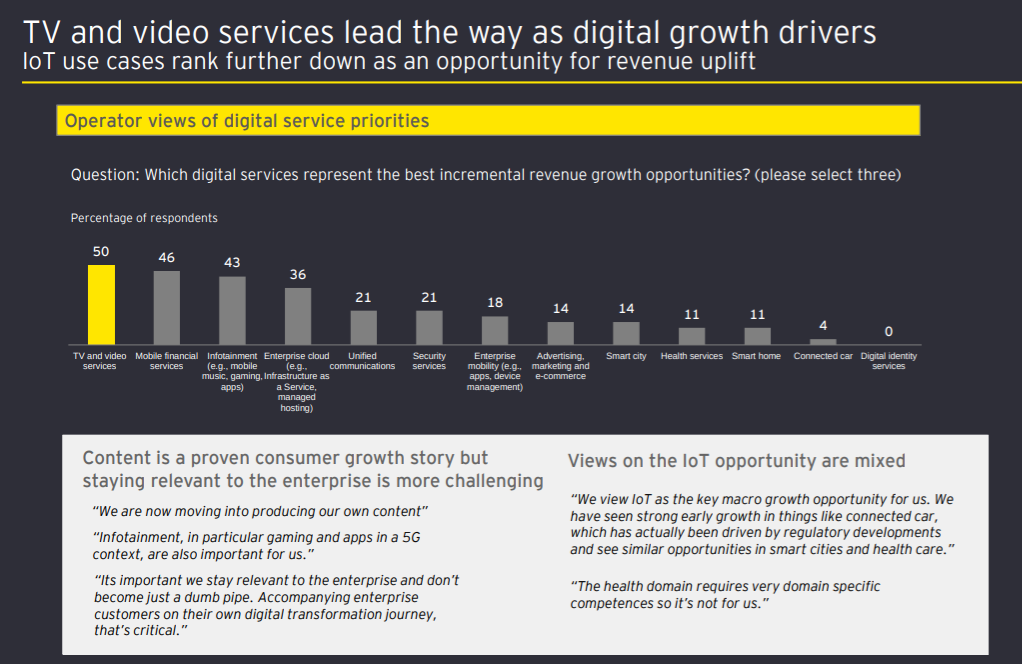
36% of Mobile Execs Seen Cloud Computing (Edge) as a Growth Driver

It should not be surprising that mobile service provider executives in 2019 view entertainment and content services as key revenue growth drivers. That is a trend under way for some time, is a large market with proven demand, and has successfully been pioneered.

Edge computing and internet of things use cases are yet developing, a survey by EY finds. That should change, over time, as proven use cases and revenue models develop.


Tuesday, December 3, 2019

AWS Goes to the Edge

Amazon Web Services Inc. (AWS) has announced AWS Wavelength,  which provides developers the ability to build applications that serve end-users with single-digit millisecond latencies over a 5G network. 

Wavelength embeds AWS compute and storage services at the edge of telecommunications providers’ 5G networks, enabling developers to serve use-cases that require ultra-low latency like machine learning inference at the edge, autonomous industrial equipment, smart cars and cities, Internet of Things (IoT), and Augmented and Virtual Reality. 

AWS customers can now use the same familiar AWS APIs, tools, and functionality they use today, to deliver-low latency applications at the edge of the 5G network, around the world, AWS says. 

AWS is partnering with Verizon, Vodafone, SK Telecom, and KDDI) to launch AWS Wavelength across Europe, South Korea, and Japan in 2020, with more global partners “coming soon,” AWS says.

Verizon Partners with AWS for Edge Computing

It was probably inevitable that Verizon is partnering with Amazon Web Services for edge computing after AT&T and Microsoft announced their partnership for 5G-enabled edge computing.

Though each telecom giant is pursuing edge computing, the choice of a different strategic partner is a pattern with a long history, as doing so creates some amount of differentiation in the offers each can create. 

Verizon, says Amazon,  is the first technology company in the world to offer 5G network edge computing, and will use AWS’s new service, AWS Wavelength, to provide developers the ability to deploy applications that require ultra-low latency to mobile devices using 5G. 

The companies say they are currently piloting AWS Wavelength on Verizon’s edge compute platform, 5G Edge, in Chicago for a select group of customers, including video game publisher Bethesda Softworks and the National Football League. 

AWS and Verizon say the partnership brings “processing power and storage physically closer to 5G mobile users and wireless devices, and enable developers to build applications that can deliver enhanced user experiences like near real-time analytics for instant decision-making, immersive game streaming, and automated robotic systems in manufacturing facilities.”

AT&T calls its platform “Network Edge Compute,” which weaves Microsoft Azure cloud services into AT&T network edge locations closer to customers. That means AT&T customers will be able to use Azure services at the edge. 

Monday, December 2, 2019

AI Seen as Driving Edge Computing

Support for artificial intelligence processes is among the biggest benefits organizations seek from edge computing. Reducing latency is the other key expected benefit, according to Forrester Research. In 2018, the stated value was more support for internet of things apps. 

Edge computing was on the 2018 agenda, seems to be on the 2019 agenda and undoubtedly will also be on the 2020 agenda. “Fifty seven percent of mobility decision makers surveyed in the Forrester Analytics Global Business Technographics® Mobility Survey, 2019, said they have edge computing on their roadmap for the next 12 months,” Forrester Research says. 

Keeping in mind that the market is quite young, Forrester Research predicts that the edge cloud services market will grow by at least 50 percent in 2020. The main effort will be to supply basic infrastructure-as-a-service (IaaS) and advanced cloud-native programming services on distributed edge computing infrastructure, according to Forrester. 

The goal is to enable IaaS and platform-as-a-service (PaaS) services that run independently of or with only intermittent connectivity to public cloud and data center assets. That implies substantial “compute at the edge” capabilities, as apps will have to be architected to run locally, with periodic remote data center support.