Thursday, May 9, 2019

Are Metro Data Centers Good Enough for Low-Latency Edge Apps?

How great are the advantages of infrastructure edge computing that is widely distributed within a single metro area? Not so clear, says Raul Martynek, DataBank CEO.

To be sure, 5G dramatically reduces the latency of the air interface, dropping round trip times from an average of 50 milliseconds to 60 ms (or greater) to sub-10 ms, Martynek says.

“With 5G, most cloud data centers will be 25 ms to 50 ms away from end-users, a significant improvement over 4G,” he argues. Deploying five smaller sites within a single metro area might improve round-trip latency by one to two milliseconds, he says.

“Once an application is deployed in a single location in a given market, the actual latency to reach any eyeball in that market is dramatically reduced compared to the common East/Central/West configuration of web scale data centers and the incremental benefits of micro data centers evaporate,” when 5G access is deployed, he argues.

So for many applications, requiring round-trip latency of three ms to five ms, for example, a single metro data center might work.

“It seems logical to us that before the large cloud and content players deploy at 10,000 cell tower locations, they will first deploy a single cluster in a traditional data center in the top metro markets that they are looking to service and be able to reach any eyeball in those geographies with very low latency,” Martynek says.

Such improvements obviously are relevant for any discussion of whether network slicing, for example, might allow creation of quality-assured customized networks with guaranteed levels of service (latency, packet loss, bandwidth, for example).

Many believe a new opportunity to supply quality-of-service guarantees on virtualized, 5G and other networks will exist. The counter argument is that routine levels of service will be so much better that it will be hard to convince most customers to pay for the higher-cost QoS-assured tiers of service.

That might especially be true for consumer customers.

Some might argue that 5G and better networks, growing competition for internet access services, plus content encryption, have killed the means and the demand for quality-assured consumer broadband services.

Even if ISPs wanted to sell services that prioritize quality, the technical ability to do so, and the consumer demand, are not present.

Ignore for a moment the politics of network neutrality. It can be argued that internet service providers rapidly are losing the technological ability to “degrade” or “slow down,” much less identify, packets they deliver. And without packet visibility, it is impossible to apply the quality of service mechanisms net neutrality proponents fear.

Keep in mind that any attempt to categorize and apply service level features to internet content becomes impossible when the data is encrypted. QoS packets are encrypted at the edge, by the app providers themselves.

When that happens, service providers cannot prioritize, because they have no idea what actual class or category of content is delivered. In other words, they cannot “tamper with what they cannot see. And that is the growing trend as most traffic gets encrypted.  

By about 2020, estimates Openwave Mobility, fully 80 percent of all internet traffic will be encrypted. In 2017, more than 70 percent of all traffic is encrypted.

There are other reasons packet discrimination is not possible, for technical and business reasons.

Can 5G service providers charge a premium for low-latency performance guarantees, when the stated latency parameters--best effort--are already so low? Could they charge a higher fee for faster speeds, when faster speeds are the norm?

That, essentially, is among the implications of fast 5G networks and metro-level computing.

Wednesday, May 8, 2019

AI at the Edge

Will Google bring deep learning to the deep learning to the device? It appears that will be the case. In fact, AI is expected to be deployed mostly at the edge, and not in traditional data centers.


Traditionally, hardware limitations have made this too prohibitive. But prices are really dropping.


Google CEO Sundar Pichai says Google deep learning models, which were previously up to 100 GB in size, have been scaled down to 0.5 GB.


“What if we could bring the AI that powers Assistant right onto your phone?” said Scott Huffman, VP of Engineering for Google Assistant.


For purposes of clarity, smartphones have not traditionally been considered “things.” That appellation has been reserved for other appliances or sensors not intended to be used by humans.


For purposes of plotting the value of edge computing, the distinction might not matter, as much of the consumer IoT space (smartwatches, for example) features devices which are used by humans.


Tuesday, May 7, 2019

Microsoft Makes Play for Edge

SQL Server and Azure SQL Database are the leading data engines for enterprise workloads on-premises and in the cloud, respectively, and Microsoft wants to leverage those assets at the edge with Azure SQL Database Edge.

Azure SQL Database Edge runs on ARM processors and provides capabilities like data streaming and time series data, with in-database machine learning and graph. And because Azure SQL Database Edge shares the same programming surface area with Azure SQL Database and SQL Server, you can easily take your applications to the edge without having to learn new tools and languages, allowing you to preserve consistency in application management and security control, says Microsoft

In addition, Microsoft has developed IoT Plug and Play, a new open modeling language to connect IoT devices to the cloud seamlessly, enabling developers to navigate one of the biggest challenges they face — deploying IoT solutions at scale.

Previously, software had to be written specifically for the connected device it supported, limiting the scale of IoT deployments. IoT Plug and Play provides developers with a faster way to build IoT devices and will provide customers with a large ecosystem of partner-certified devices that can work with any IoT solution, Microsoft says.

Cloud-Based IoT Now a Growing Battleground

Cloud-based or edge-based Internet of things use cases are widely expected to grow over the coming decade. And that means there is a chance for contestants to solidify or gain market share.

Microsoft has a 23-percent share of the IoT cloud market, but only a 17 percent share of the general cloud market, illustrating the potential upside. Google has about 10-percent share of cloud computing, but perhaps 20 percent of cloud-based IoT.

Amazon now represents 34 percent of the IoT cloud market and 32 percent of the general cloud computing market.

April 2018, Microsoft announced it would invest $5 billion in IoT efforts over the next four years.


Friday, May 3, 2019

Arrow Launches Smart Airport Service

Arrow Electronics has launched what it calls the Smart Airport Asset Management Solution, in collaboration with IBM.

The solution will provide airport operators with temperature, vibration and motor fluid levels from sensors on motors and other moving parts in escalators, moving walkways and baggage handling systems.

Additionally, sensors on potable water cabinets measure temperature, open/closed door, water flow and leakage to determine if the cabinet is functional.

The solution is based on an Arrow-designed and sourced set of IoT sensors and gateways, the IBM Watson IoT platform, and IBM asset management software.

Data is collected from the sensors connected to wireless gateways, and then consolidated and analyzed on the IBM Watson IoT platform.

Wednesday, May 1, 2019

Orange, Dell to Explore Infrastructure Edge Computing

Dell Technologies and Orange will explore and develop edge computing use cases, with a heavy focus on open, virtualized platforms. The two say they will look at infrastructure edge (multi-access edge computing) use cases, business models and proof of concepts.

The plan is to explore open source consortia and partnerships for the edge ecosystem, including use of open source FPGAs, GPUs, and SmartNICs, Cloud/Virtual RAN and real-time, interactive, latency-sensitive applications.

They also will look at artificial intelligence and machine learning software running on virtual machines, using containers and bare metal servers.

The firms will explore edge infrastructure platforms supporting edge computing in the telco environment.

Monday, April 29, 2019

80% of Service Provider Execs Say Already Building Edge Computing

Some 80 percent of respondents to a 451 Research survey of global service provider executives  already are deploying mobile edge computing infrastructure or intend to deploy it ahead of their impending 5G rollouts, the 451 Research analysts say.

At a regional level, North America is far and away the leader in terms of in-progress MEC deployment, 451 Research says. Some 68 percent of respondents are already deploying MEC infrastructure to prepare for 5G deployments.

The next closest regions in terms of current MEC deployments are Latin America and the Middle East/Africa, both reporting 40 percent.


Friday, April 26, 2019

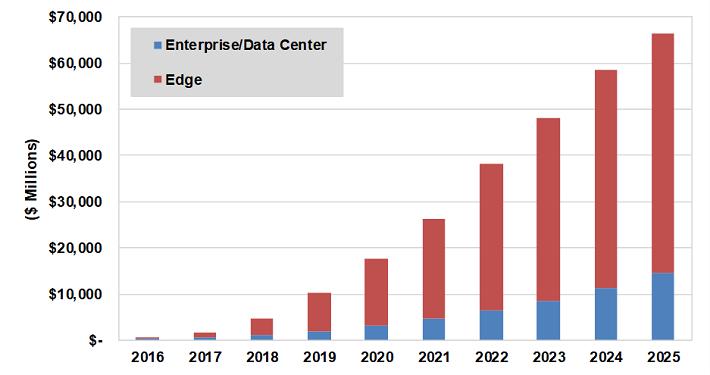
More Interest in Edge Computing to Support IoT

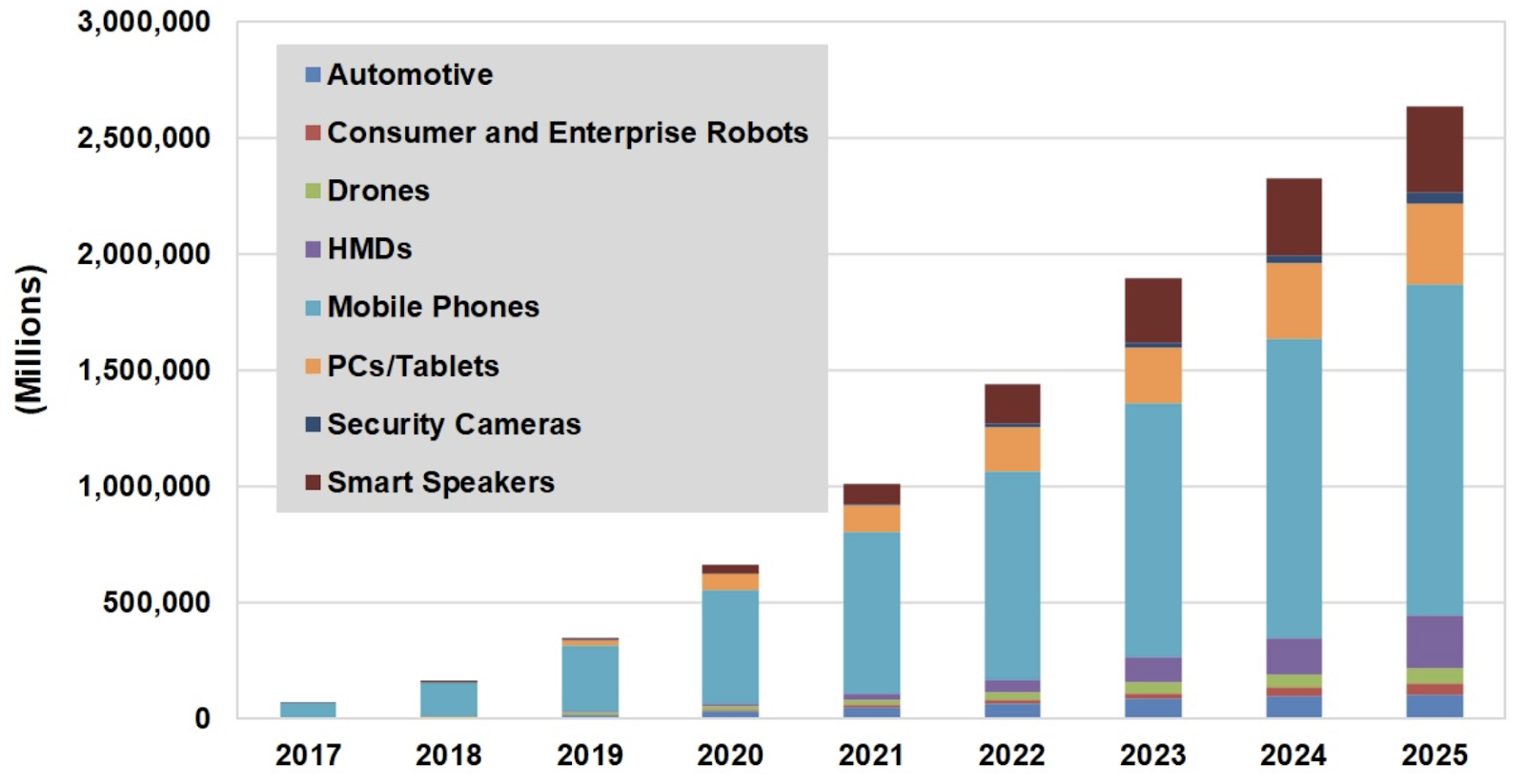
Internet of Things use cases often are ideally suited to an edge computing approach. In many cases, that is because sensors are located in a factory, and local processing is feasible. In other cases, as when lots of time-critical information is used for control purposes, local processing reduces latency.

It also can make sense to process lots of visual information locally, rather than at a remote location. 


source: Business Insider

Wednesday, April 24, 2019

60% of Firms Polled Plan IoT This Year

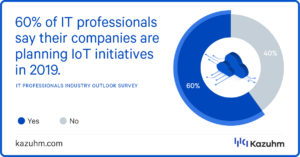
About 60 percent of respondents to a survey sponsored by Kazuhm said they were planning edge computing/IoT initiatives in 2019. Most of those entities are larger firms. “Only the smallest companies (50 employees or less) have a majority of respondents reporting they are not planning IoT initiatives this year.  

Companies with between 1000 and 5000 employees had the largest percentages reporting plans for IoT initiatives, with 68 percent saying they would do so.


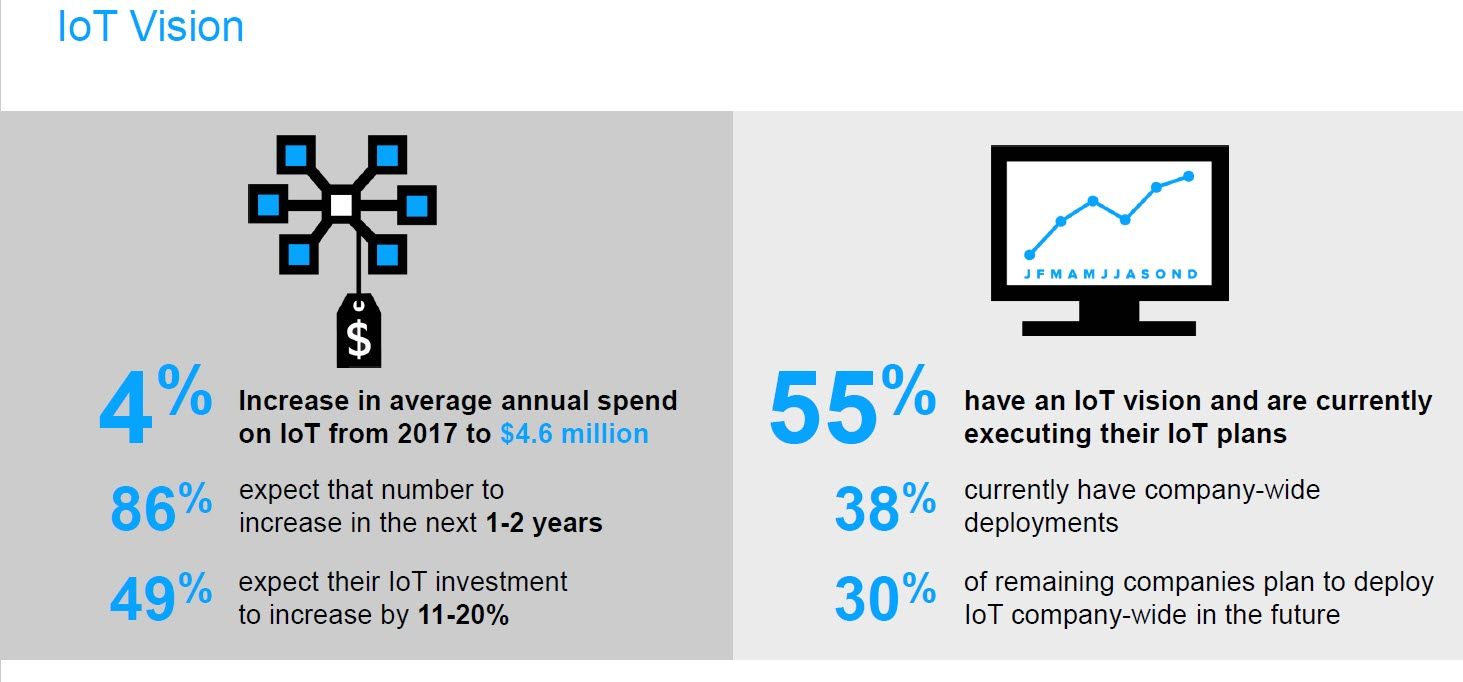
Other surveys suggest higher percentages of firms will do so. Enterprises in the United States, United Kingdom, France, Germany, Mexico, Brazil, China, India and Japan increased their IoT spending by four percent in 2018 over 2017, spending an average of $4.6 million in 2018, Zebra reports.


Some 38 percent of enterprises have company-wide IoT deployments in production today, the Zebra study suggests. .

About 84 percent of enterprises expect to complete their IoT implementations within two years.

Perhaps 90% of Sensor Data Never is Analyzed

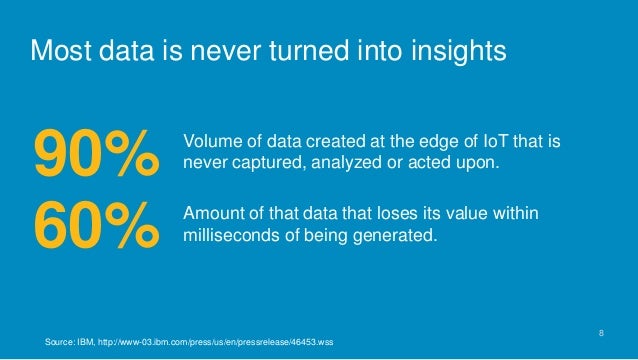
Most internet of things sensor data--as much as 90 percent--actually is not analyzed. Mostly, that is because there is no apparent value in most of that data after a few milliseconds have passed. That might be one reason why edge computing could matter. 

Image result for most data never analyzed

source: IBM 

Microsoft Acquires Express Logic for IoT Security

Microsoft has acquired Express Logic, a leader in real time operating systems (RTOS) for IoT  and edge devices powered by microcontroller units designed to work in constrained environments where safety and security are key, said Sam George, Azure IoT director.

Express Logic’s ThreadX RTOS has over 6.2 billion deployments, making it one of the most deployed RTOS in the world, said VDC Research. RTOS is used in products using low-capacity sensors such as lightbulbs, temperature gauges for air conditioners, medical devices.

More than nine billion of these MCU-powered devices, battery powered and having less than 64KB of flash memory), are built and deployed globally every year.

Microsoft gains access to billions of new connected endpoints able to use Azure Sphere, Microsoft’s security offering in the microcontroller space.

“Our goal is to make Express Logic’s ThreadX RTOS available as an option for real time processing requirements on an Azure Sphere device and also enable ThreadX-powered devices to connect to Azure IoT Edge devices when the IoT solution calls for edge computing capabilities,” said George.


“While we recommend Azure Sphere for customers’ most secured connections to the cloud, where Azure Sphere isn’t possible in highly constrained devices, we recommend Express Logic’s ThreadX RTOS,” said George.

By 2020, Gartner predicts there will be more than 20 billion connected devices in use. In April 2018, Microsoft announced we’re investing $5 billion in IoT and the intelligent edge over the next four years.

Since then, Microsoft has adapted Azure Sphere, Azure Digital Twins, Azure IoT Edge, Azure Maps and Azure IoT Central for IoT, and struck new partnerships with DJI, SAP, PTC, Qualcomm and Carnegie Mellon University for IoT and edge app development, as well as programs to help drive the next wave of innovation for customers, George noted.

Sunday, April 21, 2019

Data Center Resiliency at the Edge


Kevin Brown, SVP Innovation and CTO for Schneider Electric’s IT Division, shares his insights on why server rooms and edge closets dominate system availability . 

Friday, April 19, 2019

Industrial IoT Execs See Hybrid Edge-Cloud Computing

The top three drivers for deploying systems and connectivity at the edge are operational:
* analyzing and controlling devices
* improving process speed/reducing latency issues
* reducing data security risks

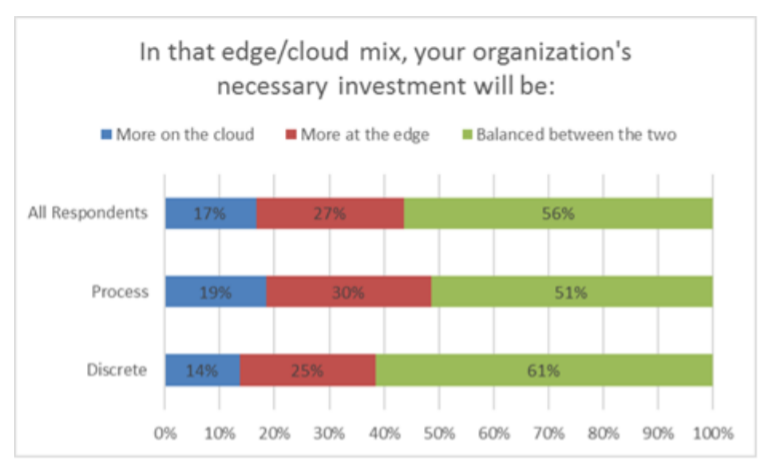
The study of industrial internet of things attitudes conducted by ARC Advisory Service has found 60 percent of respondents plan to take a hybrid approach by balancing future investments in the edge as well as the cloud. Of the 327 industrial executives, 48 percent work in North America; 30 percent in Asia; 20 percent in Europe, the Middle East and Africa.

The majority of respondents expect to deploy real-time analytics capabilities on premise and as close to the manufacturing process as possible, either at the edge, or on the plant floor level, the study funded by Stratus suggests.

About 30 percent of respondents expect to perform data analytics at the edge, and slightly fewer at the plant floor level. Fully 58 percent of respondents would not want to use the cloud as an intermediary (likely to ensure reliability and reduce response times) nor have it reside in the data center.

Some 18 percent of respondents would rely on the analytical function at the data center, while about 25 percent  would rely on cloud analytics.

source: ARC Advisory Group